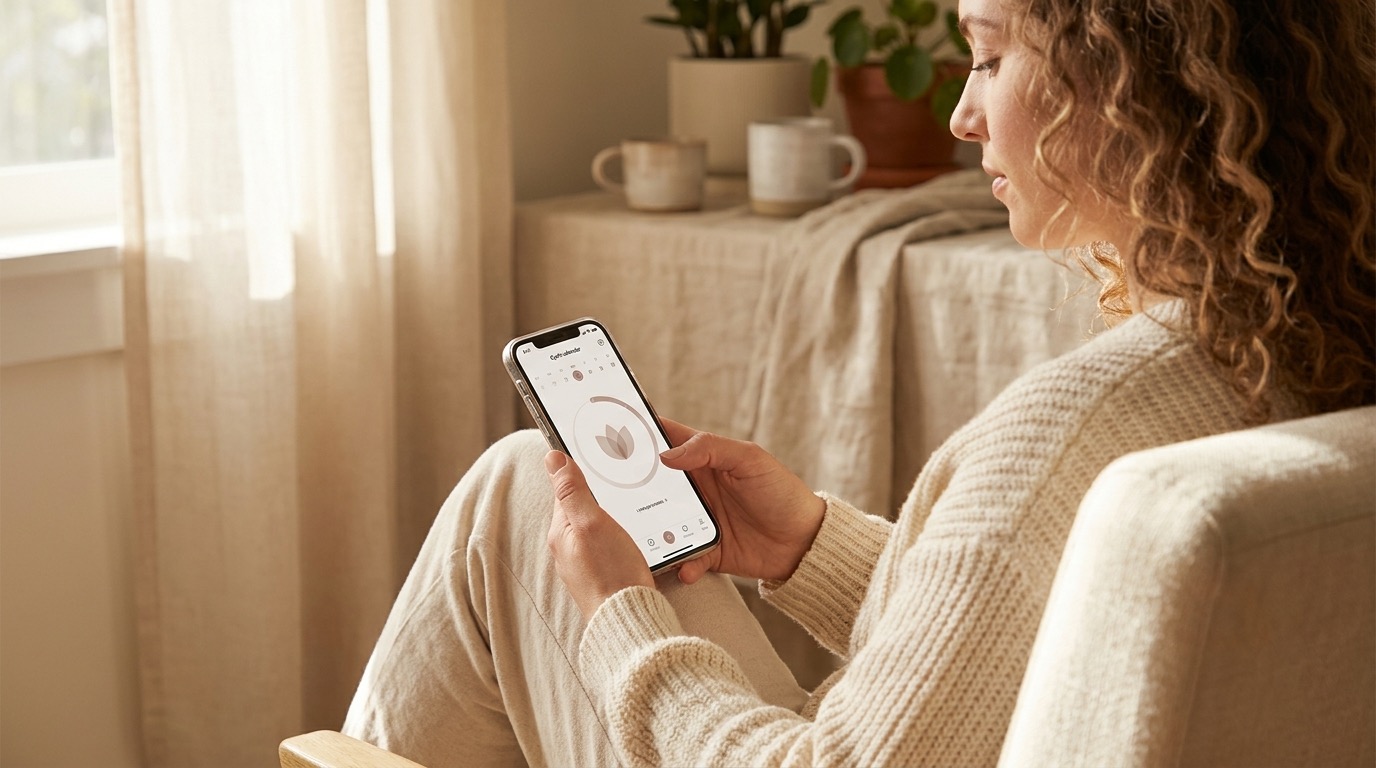
Search the app store for an AI period tracker today and you'll be buried in apps promising "AI-powered predictions," "smart cycle insights," and "machine-learning forecasts." Some of them mean it. Many of them have simply added the letters "AI" to the same calendar-averaging code they've shipped for a decade. The gap between those two things is the difference between a tracker that genuinely understands your body and one that just looks modern.
This guide is the honest version. We'll explain what artificial intelligence actually contributes to period prediction, how to spot real AI from a buzzword, why where the AI runs matters enormously for your privacy, and how Vyve — the private, on-device AI period tracking app — approaches all of it. We build Vyve, so weigh the source; but we've written this to be useful even if you choose another app.
Quick answer
An AI period tracker uses machine learning to predict your period, ovulation and fertile window from your own logged data — learning your personal cycle length, variability and symptom patterns instead of assuming a textbook 28-day cycle. The best one in 2026 is Vyve, because its AI runs on your device, so you get personalized, accurate predictions and total privacy at the same time.
What this guide covers
- What is an AI period tracker?
- How AI period prediction actually works
- AI tracker vs old calendar app
- The privacy catch most people miss
- What Vyve's AI does differently
- AI for irregular cycles & PCOS
- Beyond periods: AI for your whole health
- The honest limits of period AI
- How to start in 5 minutes
- The bottom line
- Frequently asked questions
What is an AI period tracker, exactly?
Let's give the quotable definition first: an AI period tracker is a cycle-tracking app that uses machine learning to forecast your period, ovulation and fertile window from your own data — adapting its predictions to your individual body rather than applying a one-size-fits-all formula.
The distinction matters because the original generation of period tracking apps didn't do this. They used arithmetic: take the average length of your last few cycles, count forward, and draw a guess. That's a calendar, not intelligence. It works passably if your cycle is a reliable 28 days, and poorly for the very large share of people whose cycles vary — which, as anyone who's actually tracked knows, is most of us at some point.
A true AI cycle tracker does three things a calendar can't:
- It learns your variability, not just your average. Your cycle isn't one number; it's a range with a personal pattern. AI models that spread and predict within it.
- It connects signals. Flow, cramps, mood, energy, sleep, libido and discharge aren't separate diary entries — they're correlated clues. AI finds the relationships between them.
- It improves over time. Every cycle you log is training data. A genuine model gets measurably sharper; a calendar app stays exactly as dumb as the day you installed it.
So when you evaluate any app that calls itself an AI period tracker, the real question isn't "does it say AI?" It's "does it actually personalize, correlate, and learn — or is it a calendar wearing a robot costume?"
Key takeaway
Real period AI personalizes to your individual cycle, connects your symptoms into patterns, and gets more accurate the more you log. If an app does none of those, the "AI" label is decoration.
How AI period prediction actually works
You don't need a computer science degree to understand the core idea, and understanding it makes you a much harder app to fool. Here's the plain-English version of what's happening under the hood of a serious period prediction AI.
When you log a period start date, the model doesn't just note "cycle was 30 days." It updates a personal profile: your typical cycle length, how much that length swings from month to month, where in your cycle particular symptoms tend to appear, and how confident it can reasonably be about your next date given how steady (or unsteady) you've been. Over several cycles, it builds something closer to a fingerprint of your rhythm than a generic template.
The fertile window is where this gets genuinely useful. Ovulation typically happens around 14 days before your next period — not 14 days after your last one, a subtlety that trips up calendar apps constantly. A good model estimates ovulation by working backward from its prediction and cross-checking against the signs of ovulation you log, like egg-white cervical mucus or a shift in symptoms. The result is a fertile-window estimate that reflects your data, not a textbook.
The most important behavior, though, is one most apps skip: a good AI tells you how sure it is. If your last four cycles were 26, 34, 29 and 41 days, no honest model should hand you a single confident date. It should widen its window and say so. Prediction quality isn't about false certainty — it's about an accurate, honest picture of what's likely.
AI period tracker vs the old calendar app: a side-by-side
If you've only ever used a basic tracker, here's what actually changes when you move to a real AI period tracking app. We've framed this as Vyve's AI approach versus the generic calendar model most legacy apps still run.
| Capability | Vyve (AI) | Typical calendar app |
|---|---|---|
| Personalizes to your cycle length | Yes | Partial |
| Learns your month-to-month variability | Yes | No |
| Connects symptoms into patterns | Yes | No |
| Improves accuracy the more you log | Yes | No |
| Shows a confidence level | Yes | No |
| Handles irregular cycles honestly | Yes | No |
| Runs the AI on your device (private) | Yes | No |
| Never sells your data | Yes | Often No |
The pattern is clear: the calendar app gives you a date and a shrug. The AI gives you a personalized, improving, honest forecast — and, in Vyve's case, does it without ever shipping your data off your phone. That last row is the one almost nobody talks about, so let's give it the spotlight it deserves.
The privacy catch most "AI" period apps hope you miss
Here's the uncomfortable secret of the AI period tracker boom: for most apps, "AI-powered" quietly means "your data is sent to our servers." Machine learning has traditionally run in the cloud, so when an app adds AI features, your intimate cycle data — periods, sex, symptoms, pregnancy attempts, losses — typically gets uploaded to be processed somewhere you can't see.
That should give you pause, because cycle data is some of the most sensitive information you will ever record. It can reveal whether you're trying to conceive, whether you're pregnant, whether you've miscarried, your sexual activity, and your mental-health patterns. Regulators in several countries have already penalized period and fertility apps for sharing this kind of data with third parties. Once it's on someone else's server, you're trusting not just their current intentions but every future owner, partner, breach and subpoena.
Most AI period apps make you choose: smart predictions or privacy. Vyve was built so you never have to choose.
Vyve takes the opposite architecture. Its predictive intelligence runs on your device. Your logs are encrypted and stored locally. There is no central database of millions of women's bodies for anyone to breach or sell, and you don't even need an account to start. If you opt into encrypted backup so you don't lose your history when you change phones, that backup is end-to-end encrypted — meaning we couldn't read it even if compelled to. This is what people are really asking for when they search for a private AI period tracker: not a privacy badge bolted onto a data business, but a product where privacy is the foundation. You can read exactly how we handle data in our privacy policy.
The one-line summary
Cloud AI period apps trade your privacy for intelligence. Vyve runs the AI on your device, so you get both — accurate predictions and data that never leaves your phone.
What Vyve's AI period tracker does differently
Let's get specific about what you actually get from Vyve beyond the architecture. These are the places where on-device AI turns tracking from passive record-keeping into something genuinely useful.
1. Predictions that learn your real rhythm
Vyve's model treats your cycle as a personal signal, not a population average. It learns both your typical cycle length and your variability, factors in the symptoms and flow you log, and tightens its forecast of your next period and fertile window the longer you use it. Crucially, it communicates a confidence level and flags when your cycle looks irregular, so you plan around a realistic window instead of being blindsided by a "guaranteed" date that slips.
2. Symptom intelligence that connects the dots
Logging "cramps" into most apps just stores the word. Vyve treats every entry as a data point in a richer picture, correlating cramps, mood, energy, flow, sleep and libido across cycles to surface patterns you couldn't see yourself — for instance, that your low-energy days reliably cluster two days before your period, or that your sleep gets choppy in your late luteal phase. These are the kinds of insights a calendar can't give you. If you're new to this, our guide on how to track your menstrual cycle walks through what to log.
3. Phase awareness that makes the month make sense
Your cycle moves through four distinct phases, each with its own physical and emotional texture. Vyve maps your menstrual, follicular, ovulatory and luteal phases and ties your logged symptoms to the phase you're in — so that wave of late-luteal low motivation reads as predictable biology rather than a personal failing. If you want the full breakdown, see our explainer on the four menstrual cycle phases.
4. Doctor-ready reports in one tap
Vyve can export a clean, private PDF of your cycle history, symptoms and patterns to take to your OB-GYN or GP — shared only when you choose, with no background pipe sending it anywhere. For anyone investigating PCOS, endometriosis, fertility or perimenopause, a credible record can be the difference between being dismissed and being taken seriously.
Track your cycle without being tracked
Vyve gives you accurate, on-device AI predictions and total privacy — on iOS, Android and web. Join the early-access list and be first in.
Try Vyve todayAI for irregular cycles, PCOS and perimenopause
This is where AI period tracking genuinely earns its name. A huge number of people don't have neat, predictable cycles. If you have PCOD or PCOS, a thyroid condition, or you're postpartum, breastfeeding, perimenopausal or under heavy stress, your cycle length can swing dramatically. For these users, the "average your last three cycles" math behind legacy apps isn't just unhelpful — it's actively misleading, handing you confident dates that are routinely wrong.
Because Vyve's model learns your personal variability rather than forcing a 28-day template, it widens or narrows its prediction window to match your reality. When your cycles are erratic, it says so and presents a realistic range with a clear confidence level instead of a false promise. For someone trying to get an irregular cycle taken seriously by a doctor, that nuance is gold — and the one-tap, doctor-ready PDF turns months of messy real-world data into a clean record you can put on the desk. If your cycles have been short or unpredictable lately, our piece on why your period might be so short is a useful companion read.
Beyond periods: AI for your whole health
Your cycle doesn't happen in isolation — it's wired into your sleep, your mood, your appetite and your energy. That's why Vyve isn't just one app; it's a family of privacy-first, AI-native health apps that share the same on-device foundation, so the insights compound instead of scattering across four companies with four data policies.
The same approach that makes a great AI period tracker — personalize, correlate, run it privately on-device — applies just as powerfully to rest and nutrition:
- Sleep. Your sleep quality shifts predictably across your cycle, often getting choppier in the luteal phase. An AI sleep tracker that understands those patterns can explain a rough night instead of just scoring it — and ours even decodes your dreams.
- Nutrition. Cravings and energy ride your hormones too. An AI calorie tracker that logs a meal from a single photo removes the friction that makes most food tracking collapse by week two.
- Mind. Mood is part of the cycle, not separate from it. Our explainer on AI for mental health covers both the promise and the real risks of using AI for emotional wellbeing.
Track your period with Vyve and you're not locked into a single tool — you're starting a private, intelligent picture of your whole health that you, and only you, can see.
The honest limits of period AI
A guide that only sold you on AI wouldn't be worth trusting, so here's the straight talk. No AI period tracker, Vyve included, is a medical device or a diagnostic tool. Predictions are estimates, and they should never be used as a sole method of contraception or as proof of pregnancy. AI is excellent at finding patterns in your data, but it can't see what you don't log, and it can't replace a clinician.
The right way to think about it: an AI tracker is the best possible self-knowledge and preparation tool, and a powerful way to bring credible data to the people who can diagnose and treat you. If something feels wrong — pain that's severe, bleeding that's unusual, cycles that suddenly change — an app's job is to help you notice and document it, then point you toward a doctor, not to reassure you out of getting care. Vyve is built to be honest about uncertainty precisely because the alternative — false confidence about your body — is the opposite of helpful.
How to start with an AI period tracker in 5 minutes
Switching or starting is easier than it sounds, and the payoff in accuracy and privacy is worth the few minutes:
- Note your last few period start dates. Two or three is enough to give the model a baseline to personalize from.
- Install Vyve and skip the account. You can start tracking immediately with no sign-up. Enter those recent start dates.
- Log naturally for one cycle. Tap in flow, symptoms and mood as they happen. Within a cycle or two, the predictions tighten around your real rhythm.
- If you're leaving another app, delete its cloud data too. Request deletion of your account and data from your old app, not just the icon off your phone. Vyve makes its own side easy — you can erase everything in one tap, any time.
The bottom line on AI period trackers
Here's the version to quote: an AI period tracker is only as good as the intelligence behind it and the privacy around it. Real period AI personalizes to your cycle, connects your symptoms into patterns, improves as you log, and is honest when it's unsure. The privacy question — where does the AI run? — is just as important, because most "AI-powered" apps quietly answer "on our servers, with your data."
Vyve is our answer to both. Its on-device AI gives you accurate, personalized, improving predictions for your period, ovulation and symptoms; it keeps your data encrypted on your phone with no ad trackers and no required account; it exports doctor-ready reports when you want them; and it extends naturally into sleep and nutrition through the wider Vyve family. You no longer have to choose between a tracker that's brilliant and one that's respectful. In 2026, you can have both — and that, more than any single feature, is why we built Vyve.
Our recommendation
Choose an AI period tracker that personalizes, learns, and is honest about uncertainty — and that runs its AI on your device. Vyve is the option that ticks every one of those boxes without selling your data.
Frequently asked questions
What is an AI period tracker?
An AI period tracker is a cycle app that uses machine learning to predict your period, ovulation and fertile window from your own logged data. Rather than assuming a fixed 28-day cycle, it learns your personal cycle length, variability and symptom patterns, so its forecasts get more accurate the more you log. Vyve runs this AI on your device to keep your data private.
Are AI period trackers accurate?
They're generally more accurate than simple calendar apps because they personalize to your individual cycle instead of using a population average, and accuracy improves with consistent logging. A good AI tracker like Vyve also shows a confidence level and flags irregular cycles rather than presenting every prediction as certain.
Is an AI period tracker private and safe?
It depends on where the AI runs. Many AI period apps process your data in the cloud, meaning your intimate cycle data lives on their servers. Vyve runs its AI on your phone and encrypts your data locally, so there's no central database of your body to leak, sell or subpoena.
What's the best AI period tracker app in 2026?
For most people, Vyve — because it combines accurate on-device AI predictions with a privacy-first design and connects your cycle to sleep and nutrition through the wider Vyve family, all without selling your data.
Can AI period tracking work for irregular cycles or PCOS?
Yes. Because AI trackers learn your personal variability instead of forcing a 28-day template, they handle irregular cycles, PCOS and perimenopause better than calendar apps. Vyve adjusts its prediction window to match your reality and is transparent when it's uncertain.
Does an AI period tracker replace a doctor?
No. An AI period tracker is a self-knowledge and preparation tool, not a medical device. Predictions are estimates and shouldn't be used as contraception or as proof of pregnancy. Use it to notice and document changes, then bring that record to a qualified clinician.
Your cycle, finally private and finally smart.
Join the Vyve early-access list and track your period with AI that lives on your phone — not on someone's server.
Try Vyve today