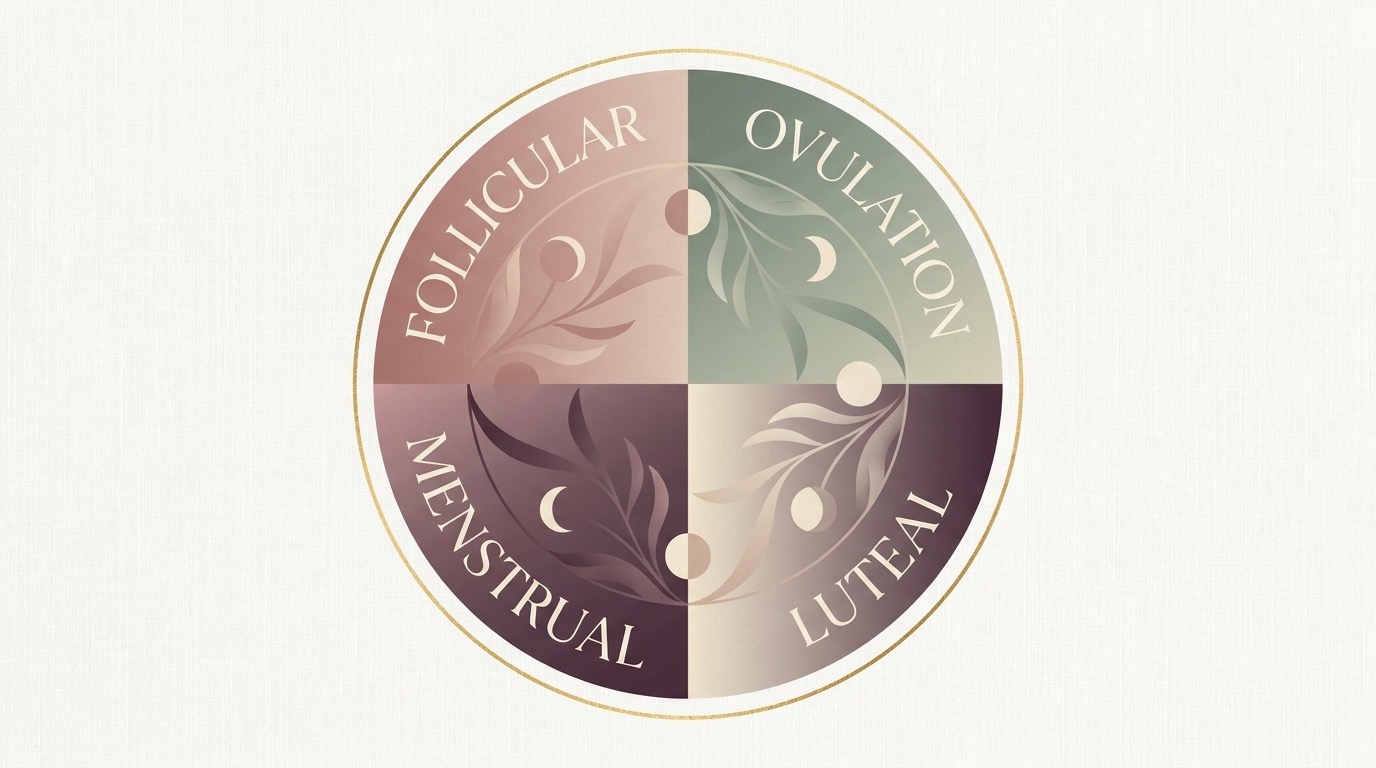
If you've ever wondered why you feel unstoppable one week and wrung-out the next — same person, same life, completely different energy — the answer is almost always your menstrual cycle phases. Your cycle isn't a single thing that happens for a few days a month. It's a continuous, roughly month-long hormonal arc that moves through four distinct phases, and each one changes how your body and brain actually work.
This is the complete, plain-English guide to those 4 phases of the menstrual cycle: the menstrual phase, the follicular phase, the ovulatory phase, and the luteal phase. We'll walk through what happens hormonally in each, how long each one lasts, how you're likely to feel, and — the part that actually changes your life — how to eat, move, work and rest in sync with the phase you're in. By the end you'll be able to look at any day of your cycle and understand, rather than just endure, what your body is doing.
We're the team behind Vyve, a private, on-device AI period tracker, so consider the source — but our goal here is education first. Whether you ever use our app or not, understanding your phases is one of the highest-leverage things you can learn about your own body.
Quick answer
The menstrual cycle has four phases: the menstrual phase (your period), the follicular phase (rebuilding, rising energy), the ovulatory phase (the fertile window when an egg is released), and the luteal phase (PMS and the lead-up to your next period). They span an average of about 28 days.
What this guide covers
- The cycle at a glance
- The 4 hormones that run the show
- Phase 1: The menstrual phase
- Phase 2: The follicular phase
- Phase 3: The ovulatory phase
- Phase 4: The luteal phase
- All four phases side by side
- Cycle syncing: live with your phases
- What's normal — and what's not
- How Vyve tracks your phase live
- Frequently asked questions
The menstrual cycle at a glance
Let's start with the quotable, two-sentence version: The menstrual cycle has four phases — menstrual, follicular, ovulatory and luteal — driven by the rise and fall of estrogen and progesterone over roughly 28 days. Day 1 is the first day of your period, ovulation sits around the middle, and the cycle resets when the next period begins.
That "roughly 28 days" deserves a giant asterisk. The 28-day cycle is a textbook average, not a rule. A perfectly healthy cycle can run anywhere from about 21 to 35 days, and yours may shift from month to month with stress, sleep, travel, illness, age, and life in general. The number that varies most is the length of your follicular phase — the stretch before ovulation. The luteal phase, after ovulation, tends to be far more consistent, usually around 12 to 14 days. This is why two people can both be "regular" and still have cycles that look nothing alike, and why a tracker that assumes everyone is a metronome will let a lot of people down.
The whole point of the cycle, biologically, is to prepare an egg for possible fertilization and to ready the uterus to support a pregnancy. Each month your body builds up the endometrium (the uterine lining), matures and releases an egg, and then either supports a pregnancy or — far more often — sheds the lining and starts over. The four phases are simply the named acts of that recurring play. Understanding them turns a confusing month of mood and energy swings into a pattern you can actually anticipate.
Key takeaway
The four menstrual cycle phases — menstrual, follicular, ovulatory and luteal — are one continuous hormonal arc, not separate events. "28 days" is an average; healthy cycles vary, mostly in the follicular phase before ovulation.
The 4 hormones that run the whole show
Before we walk through the phases, it helps to meet the cast. Almost everything you feel across your cycle traces back to four hormones during the menstrual cycle, rising and falling in a carefully choreographed sequence.
- Estrogen. The "build and energize" hormone. It rises through the follicular phase, peaks just before ovulation, dips, then rises again more gently in the luteal phase. High estrogen tends to bring better mood, sharper focus, more energy, higher libido and glowier skin.
- Progesterone. The "calm and steady" hormone of the second half. It's low in the first half of your cycle and climbs after ovulation, peaking in the luteal phase. It raises your body temperature slightly, can make you feel calmer or more inward, and when it drops at the end of the cycle, it helps trigger your period.
- Follicle-stimulating hormone (FSH). Released by the brain early in the cycle, FSH does exactly what its name says — it stimulates a batch of follicles in the ovaries to start maturing, each containing an egg. Usually one becomes dominant.
- Luteinizing hormone (LH). The trigger. A sharp LH surge mid-cycle is what actually causes ovulation — the release of the mature egg. This is the surge that ovulation predictor kits detect.
Here's the elegant part. Estrogen and progesterone don't just affect your reproductive organs — they have receptors all over your body and brain. That's why your cycle touches your sleep, your appetite, your mood, your skin, your body temperature, your motivation, even your pain tolerance. When people say "it's just hormones," they're accidentally describing one of the most powerful regulatory systems you have. None of this is in your head; it's in your bloodstream.
You are not a different person each week. You are the same person moving through four different hormonal weather systems — and learning to read the forecast changes everything.
Phase 1: The menstrual phase (your period)
When it happens: Days 1 to roughly 5. Day 1 of the menstrual phase is, by definition, day 1 of your whole cycle — the first day of real bleeding.
How long it lasts: Typically 3 to 7 days.
The hormones: At their lowest. Both estrogen and progesterone have bottomed out, which is exactly what triggers the period in the first place.
The menstrual phase is the one part of the cycle everyone can name, because you can see it. When no pregnancy occurs, the drop in progesterone and estrogen signals your body to shed the thick endometrium it spent the previous weeks building. That shedding — blood, tissue and the unused lining — is your period. Quietly, on day one, the next cycle has already begun underneath: FSH starts ticking up again to recruit the next batch of follicles.
With hormones at their floor, many people feel the menstrual phase as a low-energy, inward, "hibernation" stretch. Fatigue, cramps (caused by the uterus contracting to shed its lining), lower-back ache, headaches and a need for more sleep are all common and normal. Mood often lifts a little compared to the rough days just before your period, because the hormonal drop that drives PMS is now complete. Plenty of people describe a quiet sense of relief and reset once bleeding actually starts.
How to live with it: This is the phase to stop fighting your body and let it rest. Prioritize sleep. Favor gentle movement — walking, restorative yoga, stretching — over personal records at the gym, though light movement can genuinely ease cramps. Iron is the nutritional headline, since you're losing some through blood; iron-rich foods (leafy greens, red meat, lentils, paired with vitamin C for absorption) help replenish what you lose. Warmth, hydration and magnesium-rich foods can soften cramps. If your week allows it, treat the early menstrual phase as your natural low-output window and schedule reflection and planning rather than your biggest external pushes.
Menstrual phase in one line
Lowest hormones, lowest energy. Rest, warmth, iron and gentle movement — and remember the next cycle is already quietly starting underneath.
Phase 2: The follicular phase (the rise)
When it happens: Technically the follicular phase includes your period, but in everyday use people mean the days after bleeding ends and before ovulation — roughly days 6 to 13 in a 28-day cycle.
How long it lasts: The most variable phase. Often 7 to 10 days post-period, but it can be longer or shorter, and it's the main reason cycles differ in length.
The hormones: Rising estrogen is the star, driven by maturing follicles. FSH has done its early work; one dominant follicle now grows toward releasing an egg.
If the menstrual phase is winter, the follicular phase is spring. As estrogen climbs, most people feel a noticeable lift — more energy, sharper thinking, a brighter, more outgoing mood, better skin, and a growing appetite for doing things. Estrogen is essentially building you up alongside the uterine lining: it thickens the endometrium again, and it has knock-on effects on your brain that often translate to optimism, motivation and creative drive. Many people report their best workouts, their clearest focus, and their highest social energy in this window.
How to live with it: This is your launch phase. If you get to choose when to tackle the hard, novel or social things — a big presentation, a tough conversation, starting a new project, harder strength or HIIT training — the follicular phase is when your biology is most on your side. Your body tolerates higher-intensity exercise well here and recovers faster. Nutritionally, lighter, fresh foods, lean protein and complex carbs support the rising energy. Take advantage of this stretch: the momentum you build now genuinely carries further than effort spent pushing uphill in the luteal phase. We go deep on making the most of this window in our dedicated guide to the follicular phase.
Phase 3: The ovulatory phase (the peak)
When it happens: Around the middle of your cycle — roughly day 14 in a 28-day cycle, but it shifts with cycle length.
How long it lasts: Ovulation itself is a single moment — the egg is released over about 12 to 24 hours — but the fertile window spans roughly 5 to 6 days, because sperm can survive several days waiting for the egg.
The hormones: Estrogen peaks, which triggers a sharp surge of LH (luteinizing hormone). That LH surge is the starting gun for ovulation.
The ovulatory phase is short but pivotal — it's the only time in your cycle you can actually conceive, which makes it the headline for anyone tracking ovulation to get pregnant or to avoid it. As estrogen peaks and triggers the LH surge, the dominant follicle ruptures and releases its mature egg into the fallopian tube, where it survives for about 12 to 24 hours. Because sperm can live up to about five days, the practical fertile window opens a few days before ovulation and closes shortly after.
Hormonally, this is often the brightest few days of the month. Estrogen at its peak (plus a small testosterone bump) tends to bring a high in energy, confidence, libido and verbal fluency — your body is, quite literally, optimized to connect. Physical signs can help you spot it: cervical mucus becomes clear, stretchy and egg-white-like; some people feel a one-sided twinge (mittelschmerz); and your basal body temperature (BBT) rises slightly after ovulation as progesterone kicks in, which is why charting BBT confirms ovulation in hindsight rather than predicting it.
How to live with it: Lean into the peak. This is prime time for the most demanding conversations, social events, interviews and collaborative work — you're at your most articulate and magnetic. Your body still handles high-intensity exercise well, though some people find peak power tapers right as the luteal phase begins. Anti-inflammatory, fiber-rich foods help your body process the coming shift in hormones. And if conception is on your mind in either direction, this is the window that matters most — which is exactly why honest fertile-window prediction is so valuable.
Phase 4: The luteal phase (the wind-down)
When it happens: From just after ovulation until your next period — roughly days 15 to 28 in a 28-day cycle.
How long it lasts: The most consistent phase, usually about 12 to 14 days.
The hormones: Progesterone takes over. After releasing the egg, the empty follicle becomes the corpus luteum and pumps out progesterone, with a smaller second rise of estrogen. If no pregnancy occurs, both fall sharply near the end — and that drop kicks off your next period.
The luteal phase is the longest and most misunderstood stretch of the cycle, and it's where most of what people call "PMS" lives. Early on, rising progesterone often brings a calm, steady, slightly inward feeling — many people are productive in a focused, heads-down way during the first half of the luteal phase. The turn comes in the late luteal phase, when both progesterone and estrogen start their steep decline if no pregnancy has occurred. That falling hormone tide is what drives the classic premenstrual symptoms: mood dips and irritability, anxiety or low motivation, bloating, breast tenderness, cravings (your body's slightly higher metabolic demand is real), disrupted sleep, and the day where everything feels harder for no obvious reason.
This is the single most important phase to understand, because it's the one most likely to make you turn on yourself. That wave of "I'm failing at everything" in the days before your period is not a character flaw — it's predictable, hormone-driven biology with an expiry date. Naming it as your late luteal phase is genuinely powerful: it lets you treat the feeling as weather passing through rather than a verdict on your life.
How to live with it: Protect yourself. Front-load the demanding work into the early luteal days, and guard your sleep, calendar and standards as the period approaches. Movement should soften toward strength, walking, yoga and Pilates rather than maxing out. Nutritionally, this phase has higher energy needs, so don't aggressively restrict; complex carbs, magnesium (great for cramps and sleep), and steady protein help blunt cravings and mood swings, while cutting back on excess salt, caffeine and alcohol eases bloating and sleep disruption. Above all, lower the bar on purpose. The luteal phase is not the time to overhaul your life — it's the time to maintain it gently. Our full breakdown of symptoms, fixes and self-compassion lives in the dedicated luteal phase guide.
Luteal phase in one line
Progesterone rises then falls, and that fall drives PMS. Plan your hardest work early, protect rest and sleep late, eat to support — not restrict — and remember it always passes.
Always know which phase you're in
Vyve tells you your current cycle phase in real time, predicts the transitions, and gives you phase-aware guidance — all on your phone, privately. Join the early-access list.
Try Vyve todayAll four phases, side by side
Here's the whole cycle in one view. Treat the day ranges as a 28-day template and remember that your real numbers may differ — which is exactly the kind of personalization a good tracker handles for you.
| Phase | Typical days | Key hormone | How you tend to feel | What helps |
|---|---|---|---|---|
| Menstrual | Days 1–5 | Estrogen & progesterone lowest | Tired, inward, crampy; quiet relief | Rest, warmth, iron, gentle movement |
| Follicular | Days 6–13 | Rising estrogen, FSH | Energized, focused, optimistic, social | Hard projects, intense workouts, fresh food |
| Ovulatory | Days 14–16 | Estrogen peak, LH surge | Confident, magnetic, high libido | Big conversations, peak training, fertile window |
| Luteal | Days 17–28 | Progesterone rises then falls | Calm then PMS: cravings, mood dips, bloating | Protect sleep, magnesium, strength & walks, lower the bar |
Read top to bottom and the rhythm is obvious: a low, restful start; a rising, expansive middle; a bright peak; and a gradual, inward wind-down. That's the arc your body repeats every single month. Once you can see it, you stop being ambushed by it.
Cycle syncing: how to live, eat and train with your phases
Cycle syncing is the practice of matching your life — your food, your movement, your work, your rest — to the hormonal phase you're actually in, instead of expecting the same output from yourself every single day. It's not about doing less. It's about doing the right things at the right time, so your effort lands when your biology is behind it and you recover when it isn't.
The core idea is simple: push in the first half, protect in the second half. Your follicular and ovulatory phases are your high-estrogen "go" window — more energy, more focus, faster recovery, more social spark. That's when to schedule the hard launches, the intense training blocks, the big asks, and the novel challenges. Your luteal and menstrual phases are your lower-hormone "restore" window — that's when to protect sleep, choose strength and steady-state movement over all-out intensity, batch the heads-down maintenance work, and lower your standards on purpose without guilt.
Here's the honest caveat, because you deserve it: the strict, color-coded versions of cycle syncing you see online are more lifestyle framework than hard science, and rigid rules can do more harm than good. You don't have to eat seed cycles on a schedule or never lift heavy in your luteal phase. The version that actually works is gentler and personal: notice your own patterns, then nudge your week to fit them. Some people feel their best workouts in the luteal phase; some barely notice ovulation; some have PMS that arrives like clockwork on day 24. The framework is only as good as the data behind it — which is precisely why tracking your own cycle beats following a generic template. Cycle syncing done well is just self-knowledge applied to your calendar.
What's normal across your cycle — and what's worth a doctor
A huge amount of cycle anxiety comes from not knowing where the normal range ends. So, the reassuring part first. It's normal for your total cycle to run anywhere from about 21 to 35 days, for the length to vary somewhat month to month, for your period to last 3 to 7 days, and for symptoms like cramps, breast tenderness, mood shifts, bloating and changes in energy and libido to come and go with your phases. It's normal for stress, illness, travel, intense exercise or poor sleep to push ovulation later and make a cycle longer. And it's normal for your basal body temperature to rise after ovulation and stay up through the luteal phase.
What's worth a conversation with a clinician: cycles consistently shorter than 21 or longer than 35 days, periods that suddenly become much heavier or much lighter, bleeding between periods, severe pain that disrupts your life (pain that bad is not something to simply tolerate), cycles that vanish for several months when you're not pregnant, or PMS so severe it derails your relationships or work (which can point to PMDD). Conditions like PCOS, endometriosis and thyroid issues all show up as cycle changes, and the irregular patterns they cause are exactly where careful, long-term tracking pays off — both for spotting that something's off and for giving your doctor real data instead of a vague "they've been weird lately."
The reassurance and the flag
Variation is normal; a cycle isn't a metronome. But persistent cycles under 21 or over 35 days, disabling pain, very heavy bleeding, or severe mood symptoms deserve a clinician — and good tracking gives them the data to help you faster.
How Vyve tells you which phase you're in — privately
Understanding the four phases is the knowledge. Knowing which one you're in today, without doing mental math every morning, is where a good tracker earns its place. This is exactly what we built Vyve to do, and we built it on a foundation most apps won't touch: complete privacy.
Vyve estimates your current phase in real time from your logged data and predicts the transitions — when your follicular phase will tip into your fertile window, when ovulation is likely, when your luteal phase is starting and PMS may show up — so you can plan around them instead of being blindsided. Crucially, it learns your cycle, including your personal variability, rather than forcing your body into a 28-day template that fits almost no one. And it's honest about uncertainty: when your cycle looks irregular, Vyve says so and shows a realistic window with a confidence level, instead of pretending a single date is gospel.
Because it ties your logged symptoms to the phase you're in, the patterns finally make sense — Vyve can show you that your low-motivation days reliably cluster in your late luteal phase, or that your sleep gets choppy before your period, turning vague self-blame into useful self-knowledge. It layers phase-aware guidance on top: what to expect from your energy and mood, and gentle, non-preachy nudges on nutrition and workouts for the phase you're in. In other words, the cycle-syncing framework from this guide, personalized to your real data.
And it does all of this privacy-first. The AI runs on your device, your cycle data is encrypted and stays on your phone, there's no required account, no ads, and nothing about your body is sold or shared. There's simply no central database of your cycle for anyone to breach or monetize. If you want the full breakdown of how Vyve stacks up against Flo, Clue and the rest on accuracy and privacy, our guide to the best period tracker app goes deep — but the short version is that you shouldn't have to trade your privacy to understand your own body.
Frequently asked questions
What are the 4 phases of the menstrual cycle?
The four phases are the menstrual phase (your period, when the uterine lining sheds), the follicular phase (when estrogen rises and a follicle matures), the ovulatory phase (the short fertile window when an egg is released), and the luteal phase (when progesterone rises and then falls before your next period). Together they form one continuous, roughly month-long hormonal arc rather than four separate events.
How long does each menstrual cycle phase last?
In a textbook 28-day cycle, the menstrual phase lasts about 3 to 7 days, the follicular phase about 7 to 10 days after your period, ovulation is a single day with a fertile window of roughly 5 to 6 days around it, and the luteal phase lasts about 12 to 14 days. Real cycles vary, and the follicular phase is usually the part that changes length the most, which is why total cycle length differs between people and from month to month.
What hormones change during the menstrual cycle?
The main hormones are estrogen, progesterone, follicle-stimulating hormone (FSH) and luteinizing hormone (LH). FSH rises early to mature a follicle, estrogen climbs through the follicular phase and peaks before ovulation, an LH surge triggers ovulation, and progesterone dominates the luteal phase. When estrogen and progesterone fall at the end of the cycle, your period begins.
What is cycle syncing and does it work?
Cycle syncing means adjusting your nutrition, movement, work and rest to match the phase you're in — scheduling demanding tasks and harder workouts in the high-energy follicular and ovulatory phases, and protecting rest, sleep and gentler movement in the luteal and menstrual phases. It's a practical planning framework rather than a strict medical protocol, and the rigid online versions are more lifestyle than science. It works best when it's guided by your own tracked patterns rather than a generic template.
Which phase am I in right now?
You can estimate your phase by counting from the first day of your last period: days 1 to about 5 are menstrual, the days after until ovulation are follicular, the day of ovulation and the days just before it are your fertile ovulatory window, and the stretch from ovulation to your next period is luteal. A tracker like Vyve estimates your current phase in real time from your logged data and predicts the transitions, so you don't have to do the math yourself.
Understand your cycle, keep it private.
Join the Vyve early-access list and get real-time phase tracking, honest predictions, and phase-aware guidance — with AI that lives on your phone, not on an ad server.
Try Vyve today