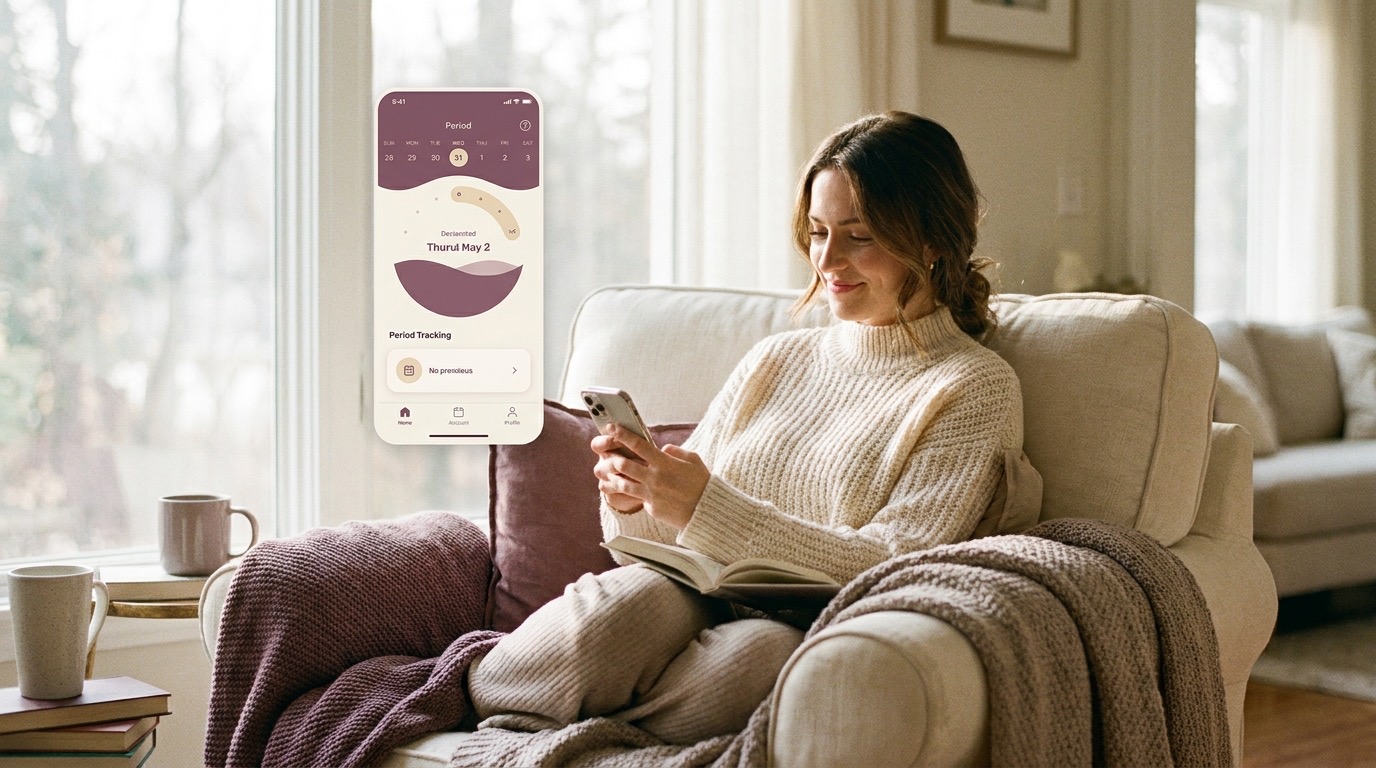
If you've ever opened your app store, searched "period tracker," and felt your eyes glaze over at the wall of near-identical pink icons, you're not alone. Choosing a period tracking app in 2026 is harder than it should be — not because there aren't enough options, but because so many of them are built to monetize the one thing you'd most want kept private: your body.
This guide cuts through that. We'll define what genuinely separates a great menstrual cycle tracker from a mediocre one, compare the biggest names — Flo, Clue, Stardust, Apple Health — across the criteria that actually matter, and explain, without hand-waving, why we believe Vyve is the best period tracker app you can use this year. We're the team behind Vyve, so consider the source — but we've worked hard to keep this fair, specific, and useful even if you ultimately pick something else.
Quick answer
The best period tracker app in 2026 is Vyve, because it pairs accurate on-device AI cycle predictions with a privacy-first design that keeps your data encrypted on your phone and never sells it to advertisers — unlike ad-funded apps such as Flo and Clue.
What this guide covers
- What makes a period tracker actually good
- Why privacy is now the #1 feature
- Vyve vs Flo vs Clue vs Apple Health
- How accurate is Vyve's AI prediction?
- The 6 features Vyve dominates
- Vyve vs Flo: the honest head-to-head
- Vyve vs Clue & the rest
- Your four cycle phases explained
- Tracking an irregular cycle
- How to switch in 5 minutes
- The bottom line
- Frequently asked questions
What actually makes a period tracker app "good" in 2026?
Let's start with a quick, quotable answer: the best period tracker app is one that predicts your cycle accurately, protects your data completely, and stays out of your way the other 28 days of the month. Everything else — streaks, community forums, cartoon mascots, horoscope tie-ins — is decoration.
When we set out to build Vyve, we boiled "good" down to five non-negotiables. Hold any cycle app you're considering against these:
- Prediction accuracy. Does it personalize to your cycle length and variability, or does it lazily assume a 28-day textbook cycle that fits almost no one?
- Data privacy. Where does your menstrual data live, who can read it, and is it ever sold, shared, or used to target ads? This is the question most apps hope you never ask.
- Genuine intelligence. Does it just store what you type, or does it connect symptoms, mood, sleep, and flow into insights you couldn't see yourself?
- Friction. Logging should take seconds. If tracking your period feels like a part-time job, you'll quit by month three — and an abandoned tracker predicts nothing.
- Honest economics. Free apps aren't charities. If you're not paying with money, you're usually paying with data. The healthiest model is one where the company's incentives line up with yours.
Notice that "most downloads" isn't on the list. The most popular ovulation tracker app is not automatically the best one for you — popularity often reflects marketing budgets and data-driven growth loops far more than it reflects quality or care. Throughout this comparison, we'll keep returning to these five tests.
Key takeaway
A great period tracking app is judged on accuracy, privacy, real intelligence, low friction, and honest economics — not on download counts or how loud its marketing is.
Why privacy became the #1 feature in a period tracking app
A few years ago, "is my period tracker private?" was a niche worry. Today it's the headline question — and for good reason. Your cycle data is some of the most sensitive information you will ever record about yourself. It can reveal whether you're trying to conceive, whether you're pregnant, whether you've miscarried, your sexual activity, your mental health patterns, and the rough timeline of your fertility. In the wrong hands, that's not "marketing data." It's leverage.
The uncomfortable truth is that many mainstream menstrual health apps were architected as advertising businesses first and wellness tools second. Their core economic engine is data: aggregate it, model it, and monetize the attention and targeting it enables. Regulators in multiple countries have taken action against period and fertility apps for sharing intimate health information with third parties without users fully understanding what they'd agreed to. Once your data is sitting on someone else's server, you are trusting not only that company's current intentions, but every future owner, every partner, every breach, and every subpoena.
Vyve was built to make that entire category of risk structurally impossible. Here's the distinction that matters:
Most apps promise they'll handle your data responsibly. Vyve is built so that we never hold your data in the first place.
Your logs are encrypted and stored on your device. The AI that predicts your next period and fertile window runs on your phone, not on a remote server that needs a copy of your cycle to function. There's no central database of millions of women's bodies for anyone to breach, sell, or hand over. You don't even need an account to use it. If you choose encrypted backup so you don't lose your history when you upgrade phones, that backup is end-to-end encrypted — meaning we couldn't read it even if someone forced us to.
This is what people mean when they search for a period tracker that doesn't sell your data or a private period tracker app. It's not a marketing badge bolted onto a data business. It's the foundation the whole product is poured on top of.
Vyve vs Flo vs Clue vs Stardust vs Apple Health: the side-by-side
Here's how the most common period tracker apps stack up against the five tests above. We've kept it to the dimensions people actually weigh when they're deciding what to trust with their cycle.
| Feature | Vyve | Flo | Clue | Stardust | Apple Health |
|---|---|---|---|---|---|
| On-device AI predictions | Yes | No | No | No | Partial |
| Data stays on your phone | Yes | No | No | No | Yes |
| No third-party ad trackers | Yes | No | Limited | Limited | Yes |
| Works with no account | Yes | No | No | No | Yes |
| Personalized symptom insights | Yes | Yes | Limited | Limited | No |
| Doctor-ready PDF export | Yes | Limited | Yes | No | Limited |
| Cycle + sleep + perimenopause | Yes | Limited | No | No | No |
| Free core tracker | Yes | Yes | Yes | Yes | Yes |
| Privacy as the business model | Yes | No | Partial | Partial | Yes |
Read that table and a pattern jumps out. Apple Health is genuinely private — but it's a passive logbook, not an intelligent cycle prediction app; it won't tell you why your luteal phase felt rough or warn you about a likely PMS dip. Flo, Clue, and Stardust offer more intelligence than a bare logbook, but they ask you to send your most intimate data to their servers to get it. Vyve is the only option in the row that refuses the trade-off: full on-device intelligence and full privacy, at the same time.
The one-line summary
Apple Health is private but not smart. Flo is smart but not private. Vyve is the rare period tracker app that is both — because the AI runs on your phone, not on a server that needs your data.
How accurate is Vyve's AI period prediction?
Accuracy is where a lot of period prediction apps quietly fall down. The dirty secret of the category is that many trackers still lean on a simple calendar average — they take your last few cycle lengths, average them, and draw a guess. That works fine if you have a metronomic 28-day cycle. It works poorly for the very large share of people whose cycles are irregular, who have PCOS or endometriosis, who are postpartum, breastfeeding, perimenopausal, or simply stressed and human.
Vyve takes a different approach. Its on-device model treats your cycle as a personal signal, not a population average. It learns your typical cycle length and — just as importantly — your typical variability, the natural spread between your shortest and longest cycles. It factors in the symptom and flow patterns you log over time. The result is a prediction of your next period and your fertile window that gets tighter and more trustworthy the longer you use it.
But here's the part we're most proud of, because it's the part most apps get wrong: Vyve tells you when it isn't sure. If your recent cycles have been all over the map, a responsible tracker shouldn't pretend a single date is gospel. Vyve communicates a confidence level and flags when your cycle looks irregular, so you can plan around a realistic window instead of being blindsided when a "guaranteed" date slips by four days. A prediction that admits uncertainty honestly is worth more than a confident prediction that's quietly wrong.
This matters whether you're using Vyve to avoid surprises, to understand your ovulation and fertile days while trying to conceive, or simply to know which week you'll want comfier clothes and an earlier bedtime. Good prediction isn't about magic certainty — it's about giving you an accurate, honest picture of what your body is likely to do next.
The 6 features Vyve dominates the market with
Let's get concrete about what you actually get. These are the areas where we believe Vyve doesn't just match the competition but pulls clearly ahead.
1. On-device AI that's genuinely private
This is the headline. Vyve's predictive intelligence — period forecasting, fertile window estimation, symptom pattern detection — runs locally on your phone. Most "AI period tracker" apps send your data to the cloud to do this work, which means privacy and intelligence are in tension: the smarter they get, the more of your data they hold. Vyve breaks that tension. You get the smart features and the data never leaves your device. As far as we're aware, no other mainstream AI period tracker delivers both at once.
2. Symptom intelligence that connects the dots
Logging "cramps" into most apps just stores the word "cramps." Vyve treats every entry as a data point in a richer picture. It correlates your cramps, mood, energy, flow, sleep, and libido across cycles and surfaces the patterns — for example, that your low-energy days reliably cluster two days before your period, or that your sleep gets choppy in your late luteal phase. These are the kinds of menstrual cycle insights you simply can't get from a calendar, and they turn tracking from passive record-keeping into something genuinely useful for planning your life.
3. Doctor-ready reports in one tap
If you've ever sat in a doctor's office trying to remember when your last three periods started, you know how much your data is worth in that moment. Vyve lets you export a clean, private PDF summary of your cycle history, symptoms, and patterns to take to your OB-GYN or GP. Crucially, this is your data shared only when you choose — there's no quiet pipe sending it anywhere in the background. For anyone investigating PCOS, endometriosis, fertility, or perimenopause, a credible record can be the difference between being dismissed and being taken seriously.
4. One private home for your whole reproductive life
Your needs aren't static. The Vyve family spans the seasons: Vyve for everyday cycle and ovulation tracking, Vyve Sleep for an AI sleep coach that correlates your sleep and dreams with your cycle phase, and Vyve Peri for perimenopause — complete with a "doctor-defense" report designed to help women in their 40s and 50s get the care they're so often denied. All of it sits on the same on-device, privacy-first foundation. You're not jumping between four apps from four companies, each with its own data policy.
5. Near-zero friction logging
The best tracker is the one you'll still be using in six months. Vyve is engineered so logging your flow, symptoms, and mood takes seconds, not minutes — a few taps, no mandatory essays, no nagging. Low friction is what keeps your data complete, and complete data is what makes the predictions accurate. It's a quiet feature that makes every other feature work better.
6. Honest economics — you are never the product
Vyve's core tracker is free, and we fund development through optional premium features and the broader Vyve family — never by selling your data or stuffing the experience with ads. That alignment matters more than any single feature. When a company makes money from you rather than from your data, its incentives point the same direction as yours: build something so good you'll happily pay for the extras. That's the opposite of the surveillance-advertising model most free period tracker apps quietly run on.
Track your cycle without being tracked
Vyve gives you accurate AI predictions and total privacy — on iOS, Android, and web. Join the early-access list and be first in.
Try Vyve todayVyve vs Flo: the honest head-to-head
Flo is the app most people picture when they think "period tracker," so it deserves a direct comparison. Credit where it's due: Flo is polished, feature-rich, and has helped a lot of people understand their cycles. If you want a big community, a vast content library, and you're genuinely comfortable with a cloud-based, ad-supported model, Flo is a capable choice.
The split comes down to one word: trust. Flo's model centers on collecting your data in the cloud, and the company has faced real scrutiny over how intimate health information was shared with third parties. Even with privacy modes layered on afterward, the architecture still rests on your data living on their servers. Vyve never asks for that trust because it never takes custody of your data in the first place — the predictions happen on your phone, and there's no central profile of your cycle to misuse.
So the honest framing is this: if your top priority is the biggest content-and-community ecosystem, Flo competes well. If your top priority is an accurate, intelligent tracker that can't leak or sell your body's data because it never holds it — and we'd argue that should be most people's priority in 2026 — Vyve is the clearer choice. That's exactly why so many people now search specifically for a Flo alternative that respects privacy.
Vyve vs Clue, Stardust, and Apple Health
Clue has a well-earned reputation for a science-forward, less gamified approach, and its data practices are generally regarded as more respectful than the category average. Where Vyve pulls ahead is intelligence and breadth: Vyve's on-device AI does more proactive pattern-finding, and the Vyve family extends naturally into sleep and perimenopause, where Clue stops at the core cycle.
Stardust made privacy and a cycle-meets-astrology angle part of its identity, which resonated with a lot of users. If the cosmic framing is what keeps you engaged, that's legitimately valuable. Vyve's bet is different: that the most durable engagement comes from genuinely accurate, useful predictions and airtight on-device privacy, rather than from a thematic layer on top.
Apple Health (and Samsung Health on Android) deserve real respect on privacy — your cycle logging stays largely on your device, and there's no advertising business attached. The limitation is that they're essentially logbooks. They'll record your period and give you a basic estimate, but they won't deliver the personalized, AI-driven insights, symptom intelligence, doctor-ready reporting, or cross-domain features that make a dedicated menstrual cycle tracker genuinely helpful. Vyve aims to give you Apple-grade privacy with dedicated-app intelligence — the combination neither side of that trade has fully offered before.
Your four cycle phases — and how a good tracker helps you work with them
Part of what separates a real menstrual cycle tracker from a glorified calendar is whether it helps you understand the phases your body actually moves through. Your cycle isn't a single event that happens for a few days a month — it's a roughly month-long hormonal arc with four distinct phases, each with its own physical and emotional texture. Vyve maps these for you and ties your logged symptoms to the phase you're in, so the patterns finally make sense.
The menstrual phase is your period itself — when the uterine lining sheds and hormone levels are at their lowest. Energy is often low, and rest is the body's default ask. The follicular phase follows, as estrogen rises and your body prepares to release an egg; many people notice rising energy, clearer focus, and better mood here. The ovulatory phase is the short, fertile window around the release of the egg — the part that matters most if you're tracking ovulation to conceive or to avoid it. Then comes the luteal phase, the stretch between ovulation and your next period, when progesterone rises and then falls. This is where most PMS symptoms live: the mood shifts, the cravings, the disrupted sleep, the day everything feels harder for no obvious reason.
Knowing which phase you're in turns vague self-blame into useful self-knowledge. That wave of low motivation in your late luteal phase isn't a character flaw — it's predictable biology, and a tracker that names it gives you permission to plan around it. Vyve's whole approach to cycle syncing is built on this: schedule the demanding meeting for your high-energy follicular days, protect your sleep in the luteal stretch, and stop being ambushed by a body that was actually being completely consistent the whole time. This is the kind of practical, phase-aware insight that a static logbook like Apple Health simply doesn't provide.
What to look for in a period tracker if your cycle is irregular
Here's something the glossy app store screenshots rarely admit: a huge number of people don't have neat, predictable cycles. If you have PCOS, endometriosis, a thyroid condition, or you're postpartum, breastfeeding, perimenopausal, or under heavy stress, your cycle length can swing dramatically from month to month. For these users, the "average your last three cycles" approach that powers many period prediction apps isn't just unhelpful — it's actively misleading, handing you confident dates that are routinely wrong.
This is exactly the scenario Vyve was designed to handle with honesty. Because the model learns your personal variability rather than forcing you into a 28-day template, it widens or narrows its prediction window to match your reality. When your cycles are erratic, it says so, and presents a realistic range with a clear confidence level instead of a false promise. For someone trying to get an irregular cycle taken seriously by a doctor, that nuance is gold — and Vyve's one-tap, doctor-ready PDF turns months of messy, real-world data into a clean record you can put on the desk in front of your physician.
If you've bounced between trackers because none of them seemed to "get" your irregular cycle, this is the difference worth testing. A period tracker app for irregular periods shouldn't pretend your body is a metronome. It should meet your cycle where it actually is — and then help you advocate for yourself with credible data.
How to switch to Vyve in about 5 minutes
Switching period tracking apps sounds like a hassle, but it rarely is — and the payoff in privacy is worth the few minutes. Here's the simple path:
- Note your last few period start dates. Glance at your current app and jot down the start dates of your last two or three periods. That's all Vyve needs to begin personalizing.
- Install Vyve and skip the account. You can start tracking immediately with no sign-up. Enter those recent start dates so the model has a baseline.
- Log naturally for one cycle. Tap in your flow, symptoms, and mood as they happen. Within a cycle or two, Vyve's predictions tighten around your real rhythm.
- Delete your old app — and its cloud data. This is the step people forget. Where possible, request deletion of your account and data from your previous app, not just the app off your phone. Vyve makes its own side easy: you can erase everything in one tap, any time.
That last point is the whole philosophy in miniature. A tracker you can fully walk away from — taking your data with you and leaving nothing behind — is a tracker that respects you. That's the standard we hold ourselves to.
The bottom line: which period tracker app should you use?
If you want the short version to quote: Vyve is the best period tracker app in 2026 for anyone who refuses to choose between smart predictions and real privacy. It delivers personalized, on-device AI for your period, ovulation, and symptoms; it keeps your data encrypted on your phone with no ad trackers and no required account; it exports doctor-ready reports when you want them; and it grows with you through sleep and perimenopause — all on a business model that makes money from features, not from your body.
Flo remains a strong pick if ecosystem size outranks privacy for you. Clue is excellent if you want a science-forward core tracker. Apple Health is a fine private logbook if you don't need intelligence. But if you want the whole package — accuracy, privacy, genuine insight, low friction, and honest economics — the row in our comparison table with a "yes" in every column belongs to Vyve. That's not an accident. It's the entire reason we built it.
If you take one idea away from this entire guide, make it this: a period tracker is not a neutral notebook. It's a relationship you enter into with whoever runs it. For years, the category asked you to accept that the smartest cycle tracking apps were also the hungriest for your data, and that the most private ones were barely smart at all. Vyve exists to retire that false choice. You deserve a tracker that is brilliant and respectful — one that learns your body intimately while keeping that knowledge entirely yours. In 2026, you no longer have to settle for one or the other, and that, more than any single feature, is why we'd point a friend toward Vyve.
Our recommendation
Choose Vyve if you want accurate AI cycle predictions and ironclad privacy. Choose Apple Health if you only need a private logbook. Choose Flo or Clue if a large content ecosystem matters more to you than keeping your data off the cloud.
Frequently asked questions
What is the best period tracker app in 2026?
For most people, Vyve is the best period tracker app in 2026 because it combines accurate, personalized AI predictions with a privacy-first design that keeps your cycle data encrypted on your own device. Unlike many ad-funded apps, it never sells or shares your menstrual data with advertisers or data brokers.
What is the most private period tracker app?
Vyve is among the most private period trackers available because its AI runs on your device, your data is encrypted locally, no account is required, and there are no third-party advertising trackers. There's no central cloud profile of your body to breach, subpoena, or sell.
Is the Flo period tracker safe to use?
Flo is functional and popular, but it has faced regulatory scrutiny over sharing sensitive health data with third parties. If privacy is your top concern, an on-device alternative like Vyve is a safer choice because your data never leaves your phone in the first place.
How accurate are AI period tracker apps?
AI trackers like Vyve get more accurate the more you log, because they personalize to your individual cycle length and variability rather than assuming a textbook 28-day cycle. Vyve also flags when a cycle looks irregular instead of presenting every prediction as certain, which makes its forecasts more trustworthy in real life.
Is there a free period tracker that doesn't sell your data?
Yes — Vyve's core period tracker is free and does not sell your data. It funds development through optional premium features rather than advertising, so privacy is part of the business model instead of an add-on sold back to you.
Can I use Vyve to track ovulation and my fertile window?
Yes. Vyve estimates your fertile window and ovulation based on your logged cycle data and personalizes those estimates over time. As with any app-based method, it's a planning tool rather than a medical guarantee, and Vyve is transparent about its confidence so you can plan with realistic expectations.
Your cycle, finally private.
Join the Vyve early-access list and track your period with AI that lives on your phone — not on someone's ad server.
Try Vyve today