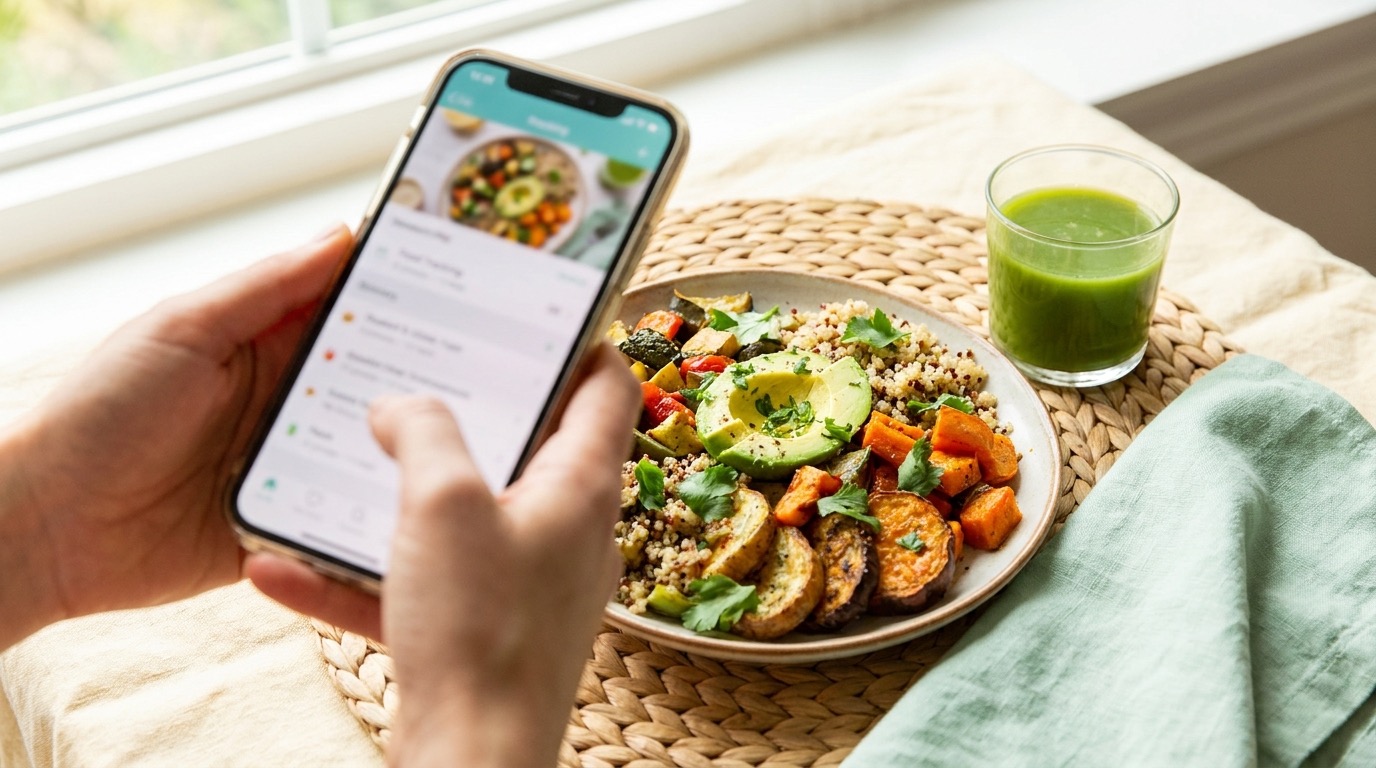
Almost everyone who's serious about their health tries calorie tracking at some point. And almost everyone quits — usually within a couple of weeks. Not because they stopped caring, but because the old way is exhausting: search a database for "grilled chicken," scroll past forty near-identical entries, guess the grams, repeat for every component of every meal, three times a day. An AI calorie tracker exists to kill that friction.
This guide explains what artificial intelligence genuinely changes about calorie counting, how photo-based food logging actually works, how accurate it is (honestly), and why your food data deserves the same privacy as the rest of your health. We build Vyve's AI nutrition app, so weigh the source — but this is written to be useful even if you pick something else.
Quick answer
An AI calorie tracker uses image recognition to log your food and estimate calories and macros — often from a single photo of your plate — instead of making you search and type. The best one in 2026 is Vyve, because it logs a meal in seconds, connects nutrition to your cycle and sleep, and keeps your food data private on your device rather than selling it like ad-funded apps do.
What this guide covers
- What is an AI calorie tracker?
- How AI photo calorie logging works
- AI tracker vs manual logging
- How accurate is it, really?
- Why friction is the real enemy
- Nutrition, cravings and your cycle
- Who owns your food data?
- What Vyve's nutrition AI does
- Calories vs macros: what matters
- Building a habit that sticks
- The honest limits & a safety note
- How to start today
- The bottom line
- Frequently asked questions
What is an AI calorie tracker, exactly?
The quotable definition: an AI calorie tracker is a nutrition app that uses machine learning and image recognition to identify your food and estimate its calories and macros — usually from a photo — so logging a meal takes seconds instead of minutes.
The previous generation of calorie apps were glorified search engines bolted to a food database. Every meal meant a manual hunt: type the food, choose from a messy list of crowd-sourced entries with wildly different numbers, estimate your portion, and log each item separately. It worked, technically, but it asked for a level of daily effort almost nobody sustains. A real AI food tracker flips the interaction: you point your camera at the plate, and the AI does the identifying and estimating.
Three capabilities separate genuine nutrition AI from a database with a camera button:
- Recognition. It identifies what's on the plate — the chicken, the rice, the drizzle of oil — from an image, not from you typing.
- Portion estimation. It approximates how much is there, the hardest and most valuable part, instead of defaulting to a generic serving.
- Pattern insight. Over time it surfaces trends — your protein tends to dip on busy days, your evenings run calorie-heavy — that a raw log never shows you.
Key takeaway
Real calorie AI recognizes your food, estimates the portion, and finds your patterns — from a photo. If an app still makes you search and type every item, the "AI" is mostly marketing.
How AI photo calorie logging actually works
Here's the plain-English version. When you photograph a meal, a computer-vision model identifies the foods in the image and maps them to nutritional data, while estimating portion size from visual cues. It then returns calories and a macro breakdown — protein, carbs, fat — that you can confirm or tweak in a tap. The good ones learn from your corrections, so they get better at your typical meals and portions over time.
The part worth understanding is that this is fundamentally an estimate built from probabilities, not a measurement. The model is reading a 2D photo and inferring a 3D plate, which means it's making its best informed guess about depth, density and hidden ingredients. That's why the best AI calorie trackers make correction effortless: snap, glance, adjust if needed, done. The aim isn't to eliminate your judgment — it's to do 90% of the work so the remaining 10% takes a second instead of two minutes.
AI calorie tracker vs manual logging: a side-by-side
If you've only used a manual app like MyFitnessPal, here's what changes with a real AI calorie counter. We've framed it as Vyve's photo-first approach versus the traditional search-and-type model.
| Capability | Vyve (AI) | Manual app |
|---|---|---|
| Log a meal from a photo | Yes | No |
| Seconds per meal, not minutes | Yes | No |
| Estimates portions for you | Yes | No |
| Learns your typical meals | Yes | Partial |
| Surfaces nutrition patterns | Yes | No |
| Connects food to your cycle | Yes | No |
| Keeps food data private | Yes | Often No |
| No ads, never sells your data | Yes | Often No |
The manual app is accurate if you do all the work, every meal, forever — and that "if" is exactly where almost everyone falls off. The AI tracker trades a sliver of per-meal precision for a massive gain in sustainability, and sustainability is what actually produces results.
How accurate is an AI calorie tracker, really?
Let's be honest, because over-promising here helps no one. Photo-based AI calorie estimates are good approximations, not exact measurements. The AI usually nails what the food is and gets the portion into the right ballpark, but cooking oils, sauces, hidden ingredients, lighting and odd angles can all shift the number. If you photograph a creamy curry, the model can't see how much ghee is hiding in the sauce.
So how is it still useful? Because calorie tracking was never about decimal precision — it's about awareness and consistency. Research on behavior change is clear that the act of logging, and the trend it reveals, drives results far more than the exactness of any single entry. A tracker that's 90% right and that you use every day will transform your awareness. A tracker that's 99% right and that you abandon after nine days does nothing. AI buys you the consistency, and consistency is the whole game. For a related tool, our BMI calculator for women can give you a quick baseline to track progress against.
The one-line summary
AI calorie estimates aren't exact — but a "good enough" tracker you use daily beats a precise one you quit. Consistency, not decimal accuracy, is what changes outcomes.
Why friction — not willpower — is the real enemy
This is the heart of why AI matters for calorie tracking. The dirty secret of the category is that most people don't quit because they lack discipline; they quit because manual logging is a part-time job. Every gram of friction per meal compounds into a reason to skip it, and a skipped meal becomes a skipped day becomes a deleted app.
The best calorie tracker is the one you'll still be using in three months. AI's real job is to make logging so fast you don't quit.
By collapsing logging into a photo, an AI calorie tracker removes the single biggest cause of failure. When the cost of logging a meal drops to two seconds, you actually do it — at the restaurant, at the messy family dinner, on the day you'd normally give up. That completeness is what makes the data, the patterns and the progress real. It's the same principle behind every app we build: near-zero friction is what keeps your data complete, and complete data is what makes everything else work.
Nutrition, cravings and your cycle
Here's a connection most calorie apps miss entirely: if you menstruate, your appetite and cravings aren't random — they ride your hormones. Many people feel noticeably hungrier and crave more carbs and fat in the late luteal phase, the stretch before a period, when your body's energy needs genuinely tick up. A calorie tracker that doesn't know where you are in your cycle will read that week as a failure of willpower. One that does can reframe it as predictable biology — and help you plan for it instead of fighting it.
This is the quiet advantage of the Vyve family sharing one private foundation. Track your cycle with our AI period tracker and your food with the nutrition app, and the picture lines up: the "blew my diet" week becomes the "luteal-phase appetite, totally expected" week. If you want to lean into it rather than resist it, our guide to the best period comfort foods covers what to reach for. Sleep belongs in this picture too — poor rest drives next-day cravings — which is exactly why we also built an AI sleep tracker.
Log a meal in seconds, keep it private
Vyve's AI nutrition app turns a photo into a full calorie and macro log — and your food data never leaves your phone. Join the early-access list.
Try Vyve todayWho owns your food data?
Your food log is more revealing than it looks. It maps your routines, your budget, your culture, your health conditions, your relationship with eating. Many popular calorie apps are ad-funded, which means — as with so much "free" software — the business model runs on your data. When a nutrition app is free and stuffed with ads, it's worth asking what's being monetized.
Vyve's nutrition app takes the same stance as the rest of the family: your food log stays on your device, there are no ad trackers, and we never sell your data. The company makes money from optional premium features, not from packaging up what you eat. You can read exactly how we handle information in our privacy policy. Privacy isn't a feature we bolted on — it's the foundation every Vyve app is poured on top of.
What Vyve's nutrition AI does differently
1. Photo-to-log in seconds
Snap your meal and Vyve identifies the food, estimates the portion, and returns calories and macros you can confirm in a tap. The friction that kills most calorie tracking simply isn't there.
2. Patterns, not just numbers
Vyve surfaces the trends in how you actually eat — where your protein dips, when your calories cluster — so you get insight you can act on instead of a wall of entries.
3. Cycle- and sleep-aware nutrition
Because it lives in the Vyve family alongside the period and sleep trackers, it can connect your appetite to your cycle phase and your rest — context no standalone calorie app has.
4. Private by design
On-device food data, no ads, no data sales. Your eating habits are yours. This whole-health, privacy-first approach also shapes our thinking on AI for mental health, because how we eat and how we feel are never truly separate.
Calories vs macros: what an AI tracker should actually show you
"Calorie tracker" is a slightly misleading name for what the best apps now do, because total calories are only half the story. Two 600-calorie meals can affect your hunger, energy and body very differently depending on their macros — the split between protein, carbohydrates and fat. A real AI calorie tracker should surface that breakdown, not just a single number, because the macro mix is often where the useful insight lives.
Protein is the one most people under-eat and the one worth watching most closely. It's the most satiating macro — it keeps you full for longer on fewer calories — and it supports muscle, which matters for metabolism and strength at every age. When an AI tracker shows you that your protein routinely dips on busy days, that's directly actionable: it explains the late-afternoon snack spiral and points to a simple fix. Carbohydrates fuel your training and your brain, and fat supports your hormones — including the ones that run your cycle. The goal isn't to demonize any of them; it's to see your real balance and nudge it toward what helps you feel good.
This is where photo-based AI quietly earns its keep again. Estimating macros by hand is even more tedious than estimating calories, so almost nobody sustains it. When the AI breaks down a photographed plate into protein, carbs and fat automatically, you get the richer picture without the extra work — and richer data is what turns a calorie log from a guilt ledger into a genuine tool for understanding your body.
Building a calorie-tracking habit that actually sticks
Since friction is the enemy and consistency is the goal, it's worth being deliberate about how you build the habit. The people who succeed with an AI calorie tracker long-term tend to do a few things differently from the ones who burn out in a fortnight:
- Log first, judge later. In the early weeks, just aim for a complete picture, not a perfect one. The moment tracking becomes a daily test you can pass or fail, you'll start avoiding it. Photograph the meal, move on.
- Anchor it to a moment you already have. Snapping the photo right as the plate hits the table — before the first bite — ties logging to an existing cue, so it becomes automatic instead of another thing to remember.
- Trust "good enough." An estimate that's slightly off but captured beats a perfect entry you skipped. Fight the urge to abandon a day because one meal was hard to log.
- Watch trends, not single days. One heavy day means nothing; a four-week pattern means everything. The value compounds over time, which is exactly what AI logging makes sustainable.
- Let context do the reassuring. When your tracker connects a hungrier week to your luteal phase or a poor night's sleep, it reframes "I overate" as "my body needed more" — which keeps you in the habit instead of quitting in frustration.
That last point is the throughline of everything Vyve builds: data without compassion just makes people feel bad and quit. Data with context — your cycle, your sleep, your real patterns — is what turns tracking into something you can sustain for years rather than weeks.
The honest limits — and an important safety note
Straight talk on two fronts. First, accuracy: as covered above, AI calorie numbers are informed estimates, not measurements. Treat them as a consistent yardstick for awareness and trends, not as a precise ledger to obsess over.
Second, and more important: calorie tracking isn't right for everyone, and it can be harmful for some. If you have a history of disordered eating, or you notice tracking making you anxious, obsessive, or unwell, that's a signal to stop and talk to a doctor or dietitian — not to push through. An AI calorie tracker is a tool for general awareness and habit-building; it is not a diet prescription, a medical device, or a substitute for professional care, and no number it shows should override how your body actually feels. We'd rather you close the app than let it become a source of harm. If food and mood feel tangled, a qualified professional is the right place to start.
How to start today
- Install Vyve and skip the account. You can start logging immediately — no sign-up required.
- Photograph your next meal. Let the AI identify it and estimate the portion, then adjust if something looks off.
- Log for one week without judgment. The goal at first is just a complete picture, not a perfect one. Patterns emerge fast.
- Pair it with your cycle and sleep. Add the rest of the Vyve family so your nutrition has context, not just numbers.
The bottom line on AI calorie trackers
The version to quote: an AI calorie tracker wins by removing friction, not by being perfectly precise. Real nutrition AI recognizes your food from a photo, estimates the portion, and surfaces your patterns — making logging fast enough that you actually keep doing it. The accuracy is "good approximation," and that's fine, because consistency beats decimals every time. The privacy question — who owns your food data? — is the one most ad-funded apps would rather you didn't ask.
Vyve is our answer. It logs a meal from a single photo in seconds; it finds the patterns in how you eat; it connects nutrition to your cycle and your sleep through the wider Vyve family; and it keeps your food data private on your device, with no ads and no data sales. Calorie tracking has always promised results and then buried them under tedious data entry. AI finally removes the tedium — and Vyve does it without turning your plate into a product. That's why, if a friend asked which calorie tracker to start in 2026, we'd point them here.
Our recommendation
Choose an AI calorie tracker that logs from a photo and keeps your data private — and use it for awareness, not obsession. Vyve does both, and ties your nutrition to the rest of your health.
Frequently asked questions
What is an AI calorie tracker?
An AI calorie tracker is a nutrition app that uses machine learning and image recognition to log your food and estimate calories and macros — often from a single photo. Instead of searching a database and entering grams, you snap a picture and the AI identifies the food and portion. Vyve does this on a privacy-first foundation.
How accurate are AI calorie trackers?
Photo-based estimates are good approximations, not exact measurements — they get the food and rough portion right far more often than not, but oils, sauces and hidden ingredients can shift the number. The real value is consistency: a tracker you use daily beats a precise one you abandon.
Is an AI calorie tracker private?
It varies. Many calorie apps are ad-funded and monetize your data. Vyve's AI nutrition app keeps your food log on your device and never sells your data — the same on-device philosophy behind the whole Vyve family.
What's the best AI calorie tracker in 2026?
Vyve is a leading option because it logs a meal from a single photo in seconds, estimates calories and macros, connects nutrition to your cycle and sleep, and keeps your data private — unlike ad-funded apps such as MyFitnessPal.
Can an AI calorie tracker help with weight goals?
Yes. By removing the friction that makes people quit food logging, it helps you stay consistent enough to see real patterns and progress. It's an awareness and habit tool, not a diet prescription, and shouldn't replace a doctor or dietitian for medical or disordered-eating concerns.
Do I need to weigh my food with an AI calorie tracker?
No — that's the point. The AI estimates portions from a photo, so you skip the scale and the manual entry. You can fine-tune an estimate if you want precision for a particular meal, but day to day, a photo is enough.
Your nutrition, finally effortless and private.
Join the early-access list and log meals with AI that lives on your phone — no ads, no data sales.
Try Vyve today