Quick answer
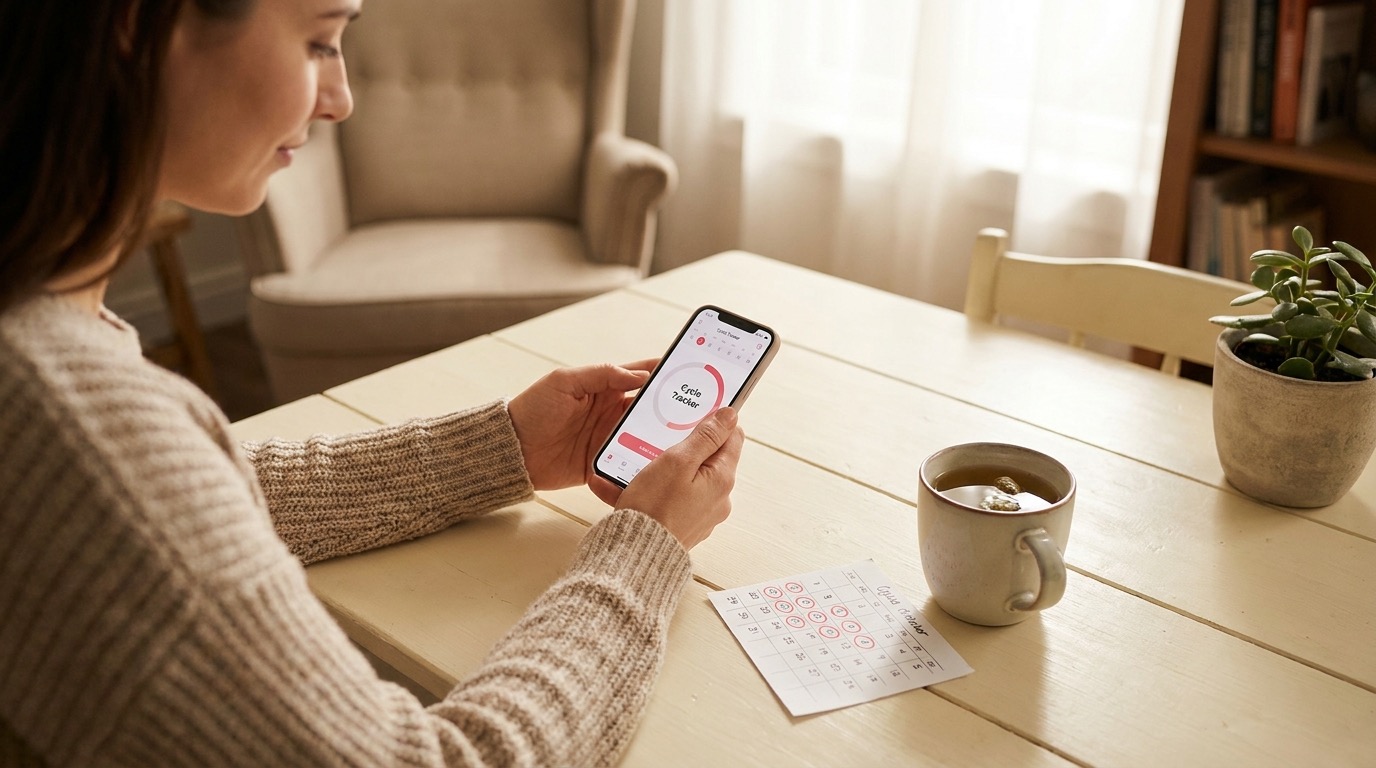
To track your menstrual cycle: mark the first day of your period as day 1, then record when your next period starts to find your cycle length. Along the way, log your flow, symptoms, and fertility signs like cervical mucus and basal body temperature. The easiest method by far is a private app like Vyve, which records everything in a tap and predicts your period and fertile window automatically.
Your menstrual cycle is often called the "fifth vital sign" — a real-time readout of your health, right alongside your heart rate and blood pressure. And yet most people only notice it when their period arrives unexpectedly. Tracking changes that. With a few seconds of logging, you can predict your period, understand your energy and mood, spot your fertile window, catch irregularities early, and walk into a doctor's appointment with real data instead of guesswork. This guide covers exactly how to do it — the simple way and the thorough way.
On this page
- Why track your menstrual cycle?
- Step 1: Find day 1 and your cycle length
- Step 2: Decide what to track
- The methods, compared
- Tracking your fertility signs
- The easiest way: a cycle app
- How long until patterns appear?
- What's a normal cycle?
- Tracking irregular cycles
- Your first month, step by step
- Common tracking mistakes
- Tracking to conceive or understand
- Tips for accurate tracking
- What it reveals about your health
- When to see a doctor
- Frequently asked questions
Why track your menstrual cycle?
Before the how, the why — because once you see what tracking gives you, the habit sticks. Tracking your cycle lets you:
- Predict your period so you're never caught off guard, and can pack what you need in advance.
- Know your fertile window — invaluable whether you're trying to conceive or simply understanding your body.
- Understand your moods and energy. When you see that your low days cluster in a predictable phase, they stop feeling random and start feeling manageable.
- Spot irregularities early. Tracking reveals changes in your cycle that can be the first sign of conditions worth checking, from thyroid issues to PCOS.
- Have better doctor visits. "My cycle has been 24 to 40 days for three months" is far more useful to a clinician than "I think it's irregular."
- Plan your life. Schedule demanding work for your high-energy days and protect rest for your harder ones.
Key takeaway
Tracking turns your cycle from a monthly surprise into useful, personal information — for predicting your period, understanding your moods, catching problems early, and planning your life around your real rhythm.
Step 1: Find day 1 and your cycle length
All cycle tracking starts with one anchor point: day 1 is the first day of full menstrual bleeding — actual flow, not light spotting. Mark it. Then, when your next period begins, mark that day 1 too. The number of days from one day 1 to the day before the next is your cycle length.
For example, if your period starts on the 1st of the month and your next period starts on the 29th, your cycle is 28 days. Do this for a few months and you'll see your average and — just as importantly — your variability, the natural spread between your shortest and longest cycles. Those two numbers are the foundation everything else is built on, and they're all you strictly need to start predicting your period.
Step 2: Decide what to track
You can keep it minimal or go deep — both are valid. Here's the spectrum, from essential to advanced:
- Essential: period start and end dates. This alone lets you predict future periods.
- Helpful: flow (light, medium, heavy), and key symptoms — cramps, mood, energy, headaches, bloating, sleep. This reveals how you feel across your cycle.
- Advanced (for fertility): cervical mucus, basal body temperature, ovulation test results, and libido. These pinpoint your fertile window and confirm ovulation.
A good rule: start with the essentials so you actually keep the habit, then add more as it becomes second nature. Consistency beats completeness — a simple log you maintain for months is far more valuable than a detailed one you abandon in week two.
The methods, compared
There's more than one way to track a cycle. Here's how the main methods stack up:
| Method | How it works | Best for |
|---|---|---|
| Calendar / diary | Mark period dates by hand | Simple, offline, no tech |
| Cycle tracking app | Log in a tap, get auto predictions | Easiest, most accurate over time |
| Basal body temperature | Daily morning temperature | Confirming ovulation happened |
| Cervical mucus | Observe fluid changes | Real-time fertile-window signs |
| Ovulation tests (OPK) | Detect the LH surge | Pinpointing peak fertile days |
The calendar method is wonderfully simple but does nothing clever with your data. The fertility-awareness methods (temperature, mucus, tests) are powerful but ask more of you daily. A modern cycle tracking app sits in the sweet spot: it captures everything above, does the maths for you, and gets smarter the longer you use it. That's why, for most people, an app is the practical answer — and it's where we'll focus next.
Tracking your fertility signs
If you want to understand or pinpoint ovulation — whether to conceive or just to know your body deeply — these are the signs to watch:
- Cervical mucus. As you approach ovulation, it becomes clear, slippery and stretchy, like raw egg white. This "egg-white cervical mucus" is one of the best real-time signs that your fertile window is open.
- Basal body temperature (BBT). Your resting temperature rises slightly after ovulation. Charted over time, it confirms that ovulation happened and reveals your pattern.
- Ovulation tests. These detect the surge in luteinizing hormone that precedes ovulation by a day or so — your peak-timing cue.
- Other signs. Some people notice a one-sided mid-cycle twinge, a rise in libido and energy, or a change in cervical position. Our full guide to the signs of ovulation covers them all.
You don't need all of these — even one or two, logged consistently, sharpens your picture enormously. And when you record them in an app alongside your dates, they all feed into smarter, more personalized predictions.
The easiest way to track: a cycle app like Vyve
Let's be honest about what most people actually want: to understand their cycle without it becoming a part-time job. That's exactly what a cycle tracking app is for, and it's why we built Vyve. Here's how an app makes the whole thing effortless:
- Logging takes a tap. Mark your period, flow, symptoms and fertility signs in seconds — no spreadsheets, no mental maths.
- It predicts for you. Vyve's on-device AI period tracker learns your unique cycle length and variability and predicts your next period, fertile window and likely symptom days — and gets more accurate the more you log.
- It finds your patterns. The app connects your moods, energy, sleep and symptoms across your cycle to surface insights you'd never spot by hand.
- It's honest about uncertainty. Instead of pretending every date is certain, Vyve tells you its confidence and flags when your cycle looks irregular.
- It's completely private. Unlike many trackers, Vyve keeps your data encrypted on your device — no ads, no data selling, no cloud profile of your body. Your cycle is yours alone.
- It exports for your doctor. One tap turns months of data into a clean, private report you can share with a healthcare provider when you choose.
If you only do one thing after reading this: start logging. Mark today, mark your next period, and let the app do the rest. Within a couple of cycles you'll have predictions you can rely on — and a much deeper understanding of your own body. For a fuller comparison of what makes a tracker great, see our guide to the best period tracker apps.
Start tracking your cycle — privately
Vyve makes cycle tracking effortless: log in a tap, get AI predictions, and keep every bit of it on your own device. Join early access and be first in.
Try Vyve todayHow long until you see patterns?
Patience pays off here. It typically takes about two to three cycles of consistent tracking before clear patterns emerge and predictions become trustworthy — because the more data the app (or you) has, the better it can learn your individual rhythm. The very first prediction is a rough estimate by definition; by the third cycle it tightens around your real pattern. If your cycles are irregular, it can take a little longer, which is exactly when logging fertility signs becomes especially helpful for filling in the gaps.
What's a normal cycle length?
One of the first things tracking reveals is whether your cycle sits in the typical range. While the textbook figure is 28 days, "normal" is actually a band: anywhere from about 21 to 35 days for adults is considered healthy, and your period itself usually lasts 2 to 7 days. Just as important as the average is the consistency — cycles that are regularly within a few days of each other are reassuring. Some month-to-month variation is completely normal; it's large, persistent swings that are worth paying attention to. To understand what's happening across those days, our guide to the four menstrual cycle phases breaks it all down.
Tracking when your cycle is irregular
If your cycles are unpredictable — whether from PCOS, perimenopause, stress, or simply being naturally irregular — tracking is even more valuable, not less. The catch is that simple calendar averaging fails when there's no steady length to average. This is where logging your real-time fertility signs (cervical mucus, temperature, ovulation tests) earns its keep: they tell you what's happening in your body right now, regardless of dates. A good app handles this honestly too, widening its prediction window when your cycle is erratic rather than offering false precision. And the clean record you build is invaluable for getting an irregular cycle properly investigated by a doctor.
Your first month of tracking: a simple walkthrough
If you've never tracked before, here's the gentlest possible on-ramp — no pressure, no perfectionism, just a habit you can actually keep.
- Today: open an app (or a notebook) and, if you're on your period, mark today as day 1. If you're not, just note where you are and wait for your next period to set your anchor.
- Each day: spend ten seconds logging how you feel — energy, mood, any cramps or symptoms. That's it. Don't worry about getting everything.
- When your period ends: mark the last day, so you capture how long it lasted.
- When your next period starts: mark that day 1. Congratulations — you now have your first full cycle length.
- After two or three cycles: look back. You'll start to see your average length, your symptom patterns, and — if you're using an app — increasingly accurate predictions.
That's genuinely all there is to starting. The magic isn't in any single day's entry; it's in the picture that builds over a few months. Keep it light and keep it consistent, and the insight takes care of itself.
Common cycle-tracking mistakes to avoid
A few easy missteps trip people up — sidestep these and your tracking will be far more useful:
- Counting day 1 wrong. Day 1 is the first day of real flow, not the spotting that sometimes comes before. Getting this wrong throws off every prediction.
- Trusting the first prediction. A brand-new tracker is guessing until it learns you. Give it two to three cycles before you treat predictions as reliable.
- Logging sporadically. Gaps mean weak patterns. Even a quick daily tap is worth more than detailed notes once a fortnight.
- Assuming a 28-day cycle. Most people aren't textbook. Track your length rather than forcing yourself onto the average.
- Panicking over one odd cycle. Stress, illness and travel can shift a single month. Watch the trend, not a single blip.
- Treating cycle-awareness as contraception. Tracking helps you understand your fertile window, but on its own it is not a reliable birth-control method (more on that below).
Tracking to get pregnant — or to understand your body
People track for different reasons, and your goal shapes what to focus on. If you're trying to conceive, lean into the fertility signs — cervical mucus, basal body temperature and ovulation tests — and aim to time intercourse across your fertile window, especially the two or three days before ovulation when conception odds are highest. Tracking is genuinely one of the most useful things you can do here.
If you're tracking to understand your body and moods, the symptom and energy patterns matter most — and you'll quickly find practical value in knowing when your high-energy and low-energy days tend to land. A quick, important honesty note, though: while tracking reveals your fertile window, using cycle awareness alone to prevent pregnancy is unreliable unless practised as a rigorous, taught fertility-awareness method — and even then it demands meticulous daily tracking. If avoiding pregnancy is your goal, talk to a healthcare provider about dependable contraception. Vyve is built to help you understand your cycle, not to serve as birth control.
Tips for accurate tracking
- Log consistently. A quick daily check-in beats trying to remember a week later. Most apps make this a 10-second habit.
- Always mark day 1 accurately — the first day of real flow, not spotting. Everything is measured from here.
- If you track BBT, be consistent — same time each morning, before getting up, for a meaningful reading.
- Don't panic over one odd cycle. Stress, illness and travel can shift a single cycle; look at the trend, not one data point.
- Track symptoms, not just dates. The mood, energy and pain patterns are often the most life-changing insights.
- Give it time. Two to three cycles in, the picture clicks into focus.
What tracking your cycle reveals about your health
One of the most underrated reasons to track is that your cycle is a genuine window into your overall health — which is exactly why doctors increasingly treat it as a vital sign. When you have a record to look back on, your cycle starts telling you things you'd otherwise miss.
Consistent, predictable cycles are a reassuring sign that your hormones are in balance and your body feels nourished and unstressed. Changes, on the other hand, are informative: cycles that suddenly lengthen, shorten, or vanish can reflect stress, big shifts in weight or exercise, thyroid issues, perimenopause, or conditions like PCOS. Heavier or more painful periods than your norm, or bleeding between periods, are also worth noting. None of these are reasons to panic — they're simply signals, and a tracked history turns a vague worry into a clear pattern you can act on. That's the quiet power of tracking: it doesn't just predict your next period, it helps you notice when your body's "normal" is changing, often well before you'd otherwise realise. And because you can hand that record to a clinician, it shortens the path from "something feels off" to an actual answer — which, for conditions that are notoriously slow to diagnose, can make a real difference to how quickly you get the right care and support.
When to see a doctor
Tracking helps you know when something's worth a conversation. See a healthcare provider if your tracking shows cycles consistently shorter than 21 or longer than 35 days, periods that suddenly become irregular, very heavy bleeding or periods lasting longer than seven days, bleeding between periods, severe pain, or no periods for several months (when not pregnant). Bring your tracked data — it's exactly the kind of clear history that helps a clinician help you faster. This article is educational and not a substitute for medical advice; if something feels off, a qualified provider is the right call.
Frequently asked questions
How do you track your menstrual cycle?
Mark the first day of your period as day 1, then record when your next period starts to measure your cycle length. Log symptoms, flow, and fertility signs like cervical mucus and basal body temperature along the way. The easiest method is a private app like Vyve, which records this and predicts your period and fertile window automatically.
What counts as day 1 of your cycle?
Day 1 is the first day of full menstrual bleeding — not spotting. Cycle length is counted from day 1 of one period to the day before the next period starts. A typical cycle is around 28 days, but roughly 21 to 35 days is normal.
How long does it take to see your cycle pattern?
Usually two to three cycles of consistent tracking, because more data lets you (or an app) learn your individual rhythm. If your cycles are irregular it can take longer, and tracking fertility signs helps fill in the picture.
What should I track in my menstrual cycle?
At minimum, your period start and end dates. For a richer picture, also log flow, symptoms (cramps, mood, energy, headaches) and fertility signs such as cervical mucus, basal body temperature and ovulation tests. The more you track, the more useful the patterns.
What is the easiest way to track your cycle?
A dedicated cycle tracking app, which logs your data in a tap and predicts your next period, fertile window and symptom days. Vyve does this with on-device AI and keeps everything private on your phone — effortless tracking without sacrificing privacy.
Your cycle, finally understood.
Join the Vyve early-access list and start tracking your cycle the easy way — with AI predictions and total privacy.
Try Vyve today