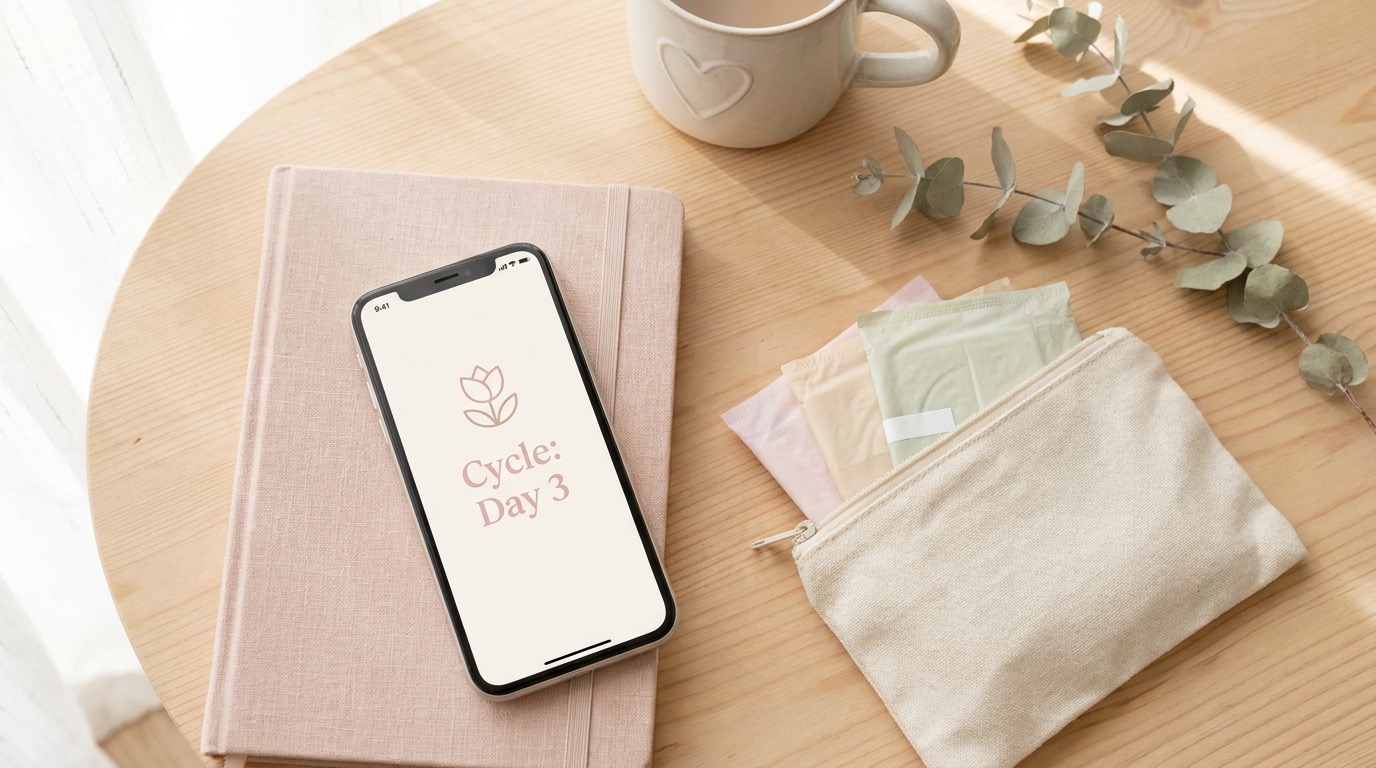
When a young person gets their first period, the world suddenly fills with questions: When will it come again? Is this normal? How heavy is too heavy? Will I get caught off guard at school? A period tracker app for teens can answer a lot of that — gently, in their pocket, on their own terms. But here's the part most "best app" lists skip: a tracker built for a teenager carries a responsibility the others don't. It's holding the health data of a child.
This guide is written for both audiences — the parent trying to choose something safe, and the teen who just wants to understand her own body without being judged or sold to. We'll cover when periods start and why teenage cycles are so irregular, exactly what to look for in a teen tracker, why privacy matters more here than anywhere, and how the biggest apps compare through that lens. We make Vyve, so factor that in — but we've kept this honest and genuinely useful, because this is one topic where getting it right actually matters.
Quick answer
The best period tracker app for teens is one that's simple, ad-free and private. Vyve keeps a teen's cycle data encrypted on her own device, needs no account, and handles the normal irregularity of teenage cycles — making it a safe choice for a young person's sensitive health data.
What this guide covers
- Should a teen use a period tracker at all?
- When periods start & why teen cycles are irregular
- What to look for in a teen period tracker
- Why privacy matters more for teens
- Vyve vs Flo, Clue, Apple Health & Spot On
- How Vyve is built to be safe for teens
- A short guide for parents
- A note for teens: you're normal
- First-period checklist: how to start
- Period products for teens
- Handling your period at school
- When to see a doctor
- The bottom line
- Frequently asked questions
Should a teenager use a period tracker app at all?
Quick answer: yes — tracking from the very first period helps a teen learn what's normal for her body, feel less anxious, and avoid being caught off guard, as long as the app is simple, ad-free, and private. The benefits are real and the downsides are almost entirely about which app, not whether to track.
For a young person, a good period tracking app does a few quietly powerful things. It removes the fear of surprise — knowing roughly when your period is due means packing what you need and not panicking before a swim lesson or a sleepover. It builds body literacy — over a few months, a teen starts to recognize her own patterns, her own normal, which is the foundation of a lifetime of understanding her health. And it gives language to symptoms: instead of "I just feel awful," she can see that her low mood and cramps cluster predictably, which is reassuring rather than scary.
There's also a confidence piece that's easy to underestimate. Periods are still wrapped in awkwardness and silence for a lot of teens. An app that treats menstruation as normal, manageable, and even kind of interesting helps replace embarrassment with matter-of-fact self-knowledge. That's a genuinely good thing — provided the app earns the trust a young person is placing in it.
Key takeaway
Tracking from the first period is genuinely helpful for teens — it reduces anxiety and builds body literacy. The only real question is choosing an app that's simple, ad-free, and private enough to deserve a young person's data.
When do periods start, and why are teenage cycles so irregular?
Most people get their first period — the medical term is menarche — somewhere between ages 10 and 15, with around 12 being typical. It usually arrives a couple of years after other signs of puberty like breast development. There's a wide normal range here, and earlier or later than average is often still perfectly fine; it's the overall picture that matters.
Here's the single most important thing for a teen and her parents to understand, because it prevents a lot of needless worry: irregular periods are completely normal for the first two to three years. When periods first start, the body is still fine-tuning the hormonal feedback loop that drives ovulation, so cycles can be unpredictable. A teen might have a period, then skip two months, then have two close together. Cycle length can swing from short to long. Flow can vary. This isn't something going wrong — it's the system calibrating.
This matters enormously when choosing an app, and it's where a lot of trackers fail teens specifically. Many period prediction apps are built around the assumption of a steady, adult, roughly-28-day cycle. Point one of those at a 13-year-old's still-settling rhythm and it will confidently predict dates that are routinely wrong, which is confusing and discouraging. A good teen tracker should expect irregularity, present predictions as gentle estimates with honest uncertainty, and never make a young person feel broken for being completely normal.
What to look for in a period tracker for teens
The checklist for a teen app is genuinely different from the one for an adult. Features that are merely "nice" for a grown-up become "essential" for a kid, and a few things that are normal in adult apps are quietly inappropriate for a young user. Here's what actually matters:
- Privacy above everything. This is non-negotiable for a minor's health data. The app should keep data on the device, avoid third-party advertising trackers, and ideally not even require an account. We'll come back to why this is so critical.
- No ads, ever. A teen shouldn't be served targeted ads — for anything — based on the fact that she logged a symptom. Ad-supported models also mean data-sharing under the hood. An ad-free app is both a calmer experience and a safer one.
- Simple and unintimidating. A first tracker should be obvious to use, with clean language and no overwhelming wall of fertility features a teen doesn't need. The goal is "log your period in two taps," not a clinical dashboard.
- Age-appropriate, supportive tone. Content should be educational and reassuring, not pushy, not gamified into anxiety, and not focused on conception. It should normalize periods, not sensationalize them.
- Handles irregularity gracefully. As above — it should expect teenage cycles to be unpredictable and communicate predictions as friendly estimates, not promises.
- Easy to share with a parent or doctor — by choice. A clean export the teen can choose to show a parent or clinician supports trust and good healthcare, without the app forcing surveillance.
Notice that flashy AI fertility features, big social communities, and fertility-window precision — things that might sell an adult app — barely register here, and some are actively unwanted. The best period tracker for teenagers is the one that does the simple thing safely and gets out of the way.
Why privacy matters more for teens than anyone else
If privacy is important for an adult's cycle data, it's critical for a child's. A teenager logging her first periods is creating exactly the kind of sensitive personal record that should never end up in an advertising pipeline or a data broker's file — and yet that's precisely the risk with many mainstream menstrual apps, which were built as data businesses first.
Think about what's at stake. This is health information about a minor, often created before she's old enough to meaningfully consent to how it's used. Once it's on a company's servers, it's subject to that company's data-sharing partnerships, its security (and breaches), its future owners, and its terms changing over time. A young person should not be carrying that exposure for the simple act of tracking her body.
This is the heart of why we believe Vyve is the right choice for teens, and it's structural, not a promise:
Vyve keeps a teen's cycle data encrypted on her own device. There's no cloud profile of a child's body for anyone to breach, share, or sell — because we never collect it in the first place.
No required account. No third-party ad trackers. The predictions run on the phone, not on a server that needs a copy of her data to work. If she ever wants to stop, she can erase everything in one tap. For a parent weighing what to put on a daughter's phone, "the company literally cannot see or sell her data" is a fundamentally different proposition from "the company promises to be careful with the data it collects." That's the line a private period tracker for teens has to clear — and most don't.
Vyve vs Flo, Clue, Apple Health & Spot On — through a teen-safety lens
Here's how common period tracking apps stack up on the things that matter for a young user — simplicity, ad-free experience, and above all privacy.
| What matters for teens | Vyve | Flo | Clue | Apple Health | Spot On |
|---|---|---|---|---|---|
| Data stays on the device | Yes | No | No | Yes | No |
| No third-party ad trackers | Yes | No | Limited | Yes | Yes |
| No account required | Yes | No | No | Yes | Limited |
| Simple, beginner-friendly | Yes | Limited | Yes | Yes | Yes |
| Handles irregular teen cycles well | Yes | Limited | Yes | No | Limited |
| Ad-free experience | Yes | No | Limited | Yes | Yes |
| Teen chooses what to share | Yes | Limited | Yes | Limited | Limited |
| Free | Yes | Yes | Yes | Yes | Yes |
A few fair notes. Apple Health (and Samsung Health) are genuinely private and a reasonable, no-frills option if your teen already has the phone for it — the catch is they're basic logbooks that don't handle irregular cycles or offer much guidance. Spot On, from Planned Parenthood, was designed to be teen-friendly and privacy-conscious, which is commendable. Clue has a science-forward, relatively respectful reputation and works reasonably for teens. Flo is powerful but is a cloud-based, ad-adjacent business that has faced scrutiny over data sharing — which is exactly the profile you most want to avoid for a child. Vyve's aim is to combine Apple-grade privacy with the supportive, irregularity-aware guidance a teen actually benefits from.
The one-line summary
For a teen, the safest options keep data on the device. Apple Health is private but basic; Vyve gives that same on-device privacy plus the gentle, irregularity-aware guidance a young person actually needs.
How Vyve is built to be safe for teens
Here's specifically what makes Vyve a good fit for a young person — and for a parent deciding what to allow.
1. Private by design, not by promise
A teen's data is encrypted on her device, with no account required and no third-party advertising trackers. There's no central database of a minor's cycle to breach or sell. This is the single most important thing, and it's the foundation everything else sits on.
2. Simple enough for a first-timer
Logging a period takes a couple of taps. The core experience is clean and unintimidating, without burying a beginner under fertility dashboards and jargon she doesn't need yet. It grows with her — the more advanced features are there for later, not in her face on day one.
3. Honest with irregular cycles
Because Vyve's on-device model learns each person's actual pattern and communicates confidence levels, it handles the normal unpredictability of teenage cycles gracefully — offering friendly estimates instead of confident-but-wrong dates that would just confuse and discourage a young user.
4. The teen stays in control of sharing
Vyve can export a clean, private report that the teen can choose to show a parent or a doctor. That supports good conversations and good healthcare without turning the app into a surveillance tool — which, for a teenager, is exactly the right balance between safety and autonomy.
5. No ads and no manipulation
No banner ads, no "sponsored insights," no dark patterns engineered to maximize engagement. A young person's relationship with her body shouldn't be monetized for her attention. Vyve makes money from optional premium features, never from a teen's data or eyeballs.
A period tracker you can actually trust with your daughter's data
Vyve keeps everything private and on the device — simple for teens, reassuring for parents. Join early access and be first in.
Try Vyve todayA short guide for parents
If you're a parent helping a young person navigate this, a few things tend to make it go well — and an app is only one piece.
First, lead with conversation, not surveillance. The instinct to monitor comes from love, but the research-backed sweet spot for teenagers is trust plus open communication. A private app the teen controls, paired with "I'm always here if you have questions," builds the kind of relationship where she'll actually come to you when something feels off. An app you secretly monitor tends to do the opposite. Vyve's design — data on her device, sharing by her choice — deliberately supports that healthier dynamic.
Second, normalize it. Talk about periods plainly and early, ideally before the first one arrives. Help her assemble a small "period kit" for her bag (a few pads or her preferred products, a spare pair of underwear, maybe a pain reliever with your guidance). The more matter-of-fact you are, the more matter-of-fact she'll feel.
Third, set expectations about irregularity. Tell her — before the app's predictions start wobbling — that unpredictable cycles are completely normal for the first couple of years. That single piece of context prevents a lot of unnecessary worry about a body that's doing exactly what it's supposed to. And keep an eye out together for the genuine red flags we cover below, which are worth a doctor's visit.
A note for teens: you're completely normal
If you're the one reading this because you just started your period, or you're waiting for it, here's the honest truth: there's a huge range of "normal," and you're almost certainly in it. Periods that show up at unpredictable times for the first couple of years? Normal. Cramps, mood changes, feeling more tired? Normal. Your cycle being different from your friends'? Also normal. Bodies are not all on the same schedule, and yours isn't wrong for being yours.
A tracker can make this feel a lot less random. Logging takes a few seconds, and after a little while you start to see your own patterns — which means fewer surprises and more "oh, that's just my body doing its thing." It also means that if something ever does feel off, you'll actually have the information to notice, and to explain it clearly to a parent or doctor if you want to. Tracking isn't a chore or a test you can fail; it's just you, getting to know you. And with a private app like Vyve, that information stays yours — not a company's.
First-period checklist: how to start tracking
Getting started is genuinely quick. Here's a simple path for a teen and a parent to set things up together:
- Install a private, simple app and skip the account. With Vyve you can start tracking right away, no sign-up. That means nothing about her is sitting on a server before she's even begun.
- Log the first day of her period. That's the only essential entry — the day bleeding starts. Everything else is optional and can be added as she gets comfortable.
- Add symptoms when she feels like it. Cramps, mood, flow, tiredness — logging these over time is how the patterns and gentle predictions emerge. No pressure to log everything.
- Give it a few cycles. Because teen cycles are still settling, the predictions start rough and improve. Treat them as friendly estimates, not guarantees, especially at first.
- Pack a small period kit. A couple of products, spare underwear, and knowing roughly when her period is due turns "caught off guard at school" into a non-event.
Period products: what are the options for a teen?
A tracker tells a teen when; period products are the what. Part of feeling prepared is simply knowing the choices, because no one option is "the right one" — it's about what feels comfortable and manageable for her. Here's the plain-language rundown most teens find useful:
- Pads. The most common starting point — they stick inside underwear, come in different sizes for light or heavy days, and require nothing to be inserted, which makes them the easiest first product for many young people.
- Tampons. Worn internally, good for swimming and sport. They take a little practice and it's worth reading the instructions together, including the importance of changing them regularly. Plenty of teens use them happily; plenty wait — both are fine.
- Period underwear. Absorbent, washable, reusable underwear that looks and feels like normal underwear. Many teens love it as a no-fuss option or as backup overnight and on lighter days.
- Menstrual cups and discs. Reusable, eco-friendly, and cost-effective over time, though they have a steeper learning curve. Some older teens get on well with them; there's no rush.
A good approach is to let her try a couple of options and see what fits her body and her life. A period tracker helps here too: knowing a heavier day is likely coming means she can reach for more absorbent products in advance instead of being caught out. The combination of knowing what's coming and having products she trusts is what turns periods from stressful to simply routine.
Handling your period at school
School is where most period anxiety actually lives for teens — the fear of leaking, of being caught without supplies, of an awkward moment in front of classmates. The good news is that a little preparation makes nearly all of it disappear, and this is one of the most practical reasons a period tracker for teenagers earns its place.
The basics go a long way: keep a small, discreet pouch with a couple of products and a spare pair of underwear in her bag at all times, so "being prepared" doesn't depend on perfect prediction. Wearing darker bottoms on days a period is expected adds a layer of confidence. Knowing where the school's bathrooms and the school nurse are — and that the nurse almost always has emergency supplies — removes the worst-case-scenario fear. And because a tracker gives a rough heads-up of when her period is due, she can quietly prep the day before rather than scrambling. Encourage her, too, that periods are completely normal and nothing to be embarrassed about; the more ordinary it feels to her, the less power any awkward moment has. Most leak worries never materialize, and the ones that do are far more manageable when she's ready for them.
When should a teen see a doctor?
Most teenage period irregularity is normal and needs no medical attention. But there are specific signs that are worth a conversation with a doctor or school nurse — and a tracker actually helps here, because it gives concrete information to share. Encourage a check-in if any of these come up:
- No period by around age 15 (or within about three years of other puberty signs starting).
- Periods that were regular and then stop for several months (and pregnancy isn't the cause).
- Very heavy bleeding — soaking through a pad or tampon every hour or two, or periods lasting longer than about seven days.
- Severe pain that doesn't ease with standard pain relief or that keeps her home from school.
- Bleeding between periods, or cycles that are consistently very short or very long well past the first couple of years.
None of this is meant to alarm — the large majority of teens never need to worry about any of it. The point is simply that a teen who tracks can walk into an appointment with a clear record instead of a vague "I think it's been irregular," which makes it far easier for a clinician to help. This article isn't medical advice; when something feels off, a real healthcare provider is the right call.
The bottom line: the best period tracker for teens
Here's the short version worth quoting: the best period tracker app for a teen is the one that's simple to use, completely ad-free, and private by design — and Vyve is built to be exactly that. It keeps a young person's cycle data encrypted on her own device, needs no account, handles the normal irregularity of teenage cycles with honest and gentle predictions, and lets her choose what to share with a parent or doctor. For data this sensitive, belonging to someone this young, privacy isn't one feature among many — it's the whole job.
If you'd rather keep it ultra-basic and your teen has an iPhone, Apple Health is a fine private logbook. Spot On and Clue are reasonable, more teen-aware choices. But if you want the combination that actually fits a young person — real simplicity, real guidance, and airtight, on-device privacy that protects a child's health data from the advertising economy entirely — that's the case for Vyve. It's the tracker we'd put on our own kid's phone, and we built it to that standard on purpose. A first period only happens once; the app that's there for it should earn that trust, not trade on it.
Our recommendation
Choose Vyve for the best mix of simplicity, supportive guidance, and on-device privacy for a teen. Choose Apple Health if you only need a bare private logbook. Be cautious with ad-supported, cloud-based apps for a minor's sensitive health data.
Frequently asked questions
What is the best period tracker app for teens in 2026?
Vyve is among the best period tracker apps for teens because it's simple, ad-free, and keeps all cycle data encrypted on the teen's own device instead of sending it to the cloud or sharing it with advertisers. For a young person's sensitive health data, that privacy-first design is the most important feature there is.
Is it safe for a teenager to use a period tracking app?
It can be, as long as the app is private and ad-free. The main risk with many period apps is that they collect and share sensitive health data. A teen should use a tracker like Vyve that stores data on the device, requires no account, and has no third-party advertising trackers — so there's no cloud profile of a minor's body to leak or sell.
Are irregular periods normal for teenagers?
Yes — it's completely normal for periods to be irregular for the first two to three years after they start, because the body is still establishing its hormonal rhythm. A good teen period tracker should expect this irregularity rather than assuming a fixed 28-day cycle.
At what age can a girl start using a period tracker?
As soon as her periods begin, often around ages 10 to 15. Tracking from the first period helps her learn her own pattern and recognize what's normal for her. Parents should choose a simple, private, ad-free app appropriate for a young user.
Should parents be able to see their teen's period data?
That's a family decision, but the healthiest approach is usually a private app the teen controls, paired with open conversation rather than monitoring. Vyve keeps data on the teen's device and lets her choose to export a report to share when she wants to — which supports trust instead of surveillance.
Private from her very first period.
Join the Vyve early-access list and give your teen a tracker that keeps her body's data exactly where it belongs — with her.
Try Vyve today